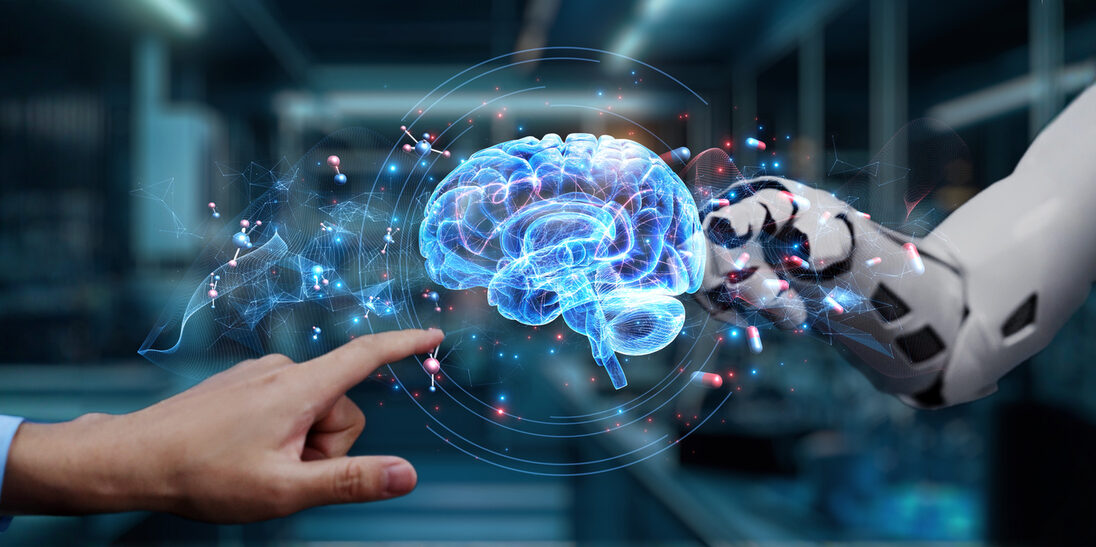
A new study at the Hebrew University suggests that the human brain processes spoken language in a way that closely mirrors how advanced AI language models work. Using electrocorticography recordings from people listening to a story, researchers found that later brain responses in key language areas, such as Broca’s area, align with deeper layers in AI models. These layers are responsible for combining context and meaning, indicating that the brain may construct understanding through a similar step-by-step hierarchy rather than through simple rule-based operations.
Published in Nature Communications, the study was led by Dr Ariel Goldstein of the Hebrew University, in collaboration with Dr Mariano Schain from Google Research, and Prof Uri Hasson and Eric Ham from Princeton University. The team uncovered a striking correspondence between the brain’s unfolding response to speech and the layered architecture of large language models.
What the study found
When we listen to speech, the brain converts each word into meaning through a cascade of neural computations over time. The researchers showed that this temporal cascade parallels the tiered structure of AI language models: early layers track relatively simple aspects of words, while deeper layers integrate context, tone and higher-level meaning. In the brain, early neural responses correlated more strongly with early model layers, whereas later responses mapped onto deeper layers.
This pattern was especially clear in high-level language regions such as Broca’s area, where peak brain responses occurred later in time for information best captured by deeper AI layers. As Dr Goldstein explains, what is striking is how closely the brain’s time course of building meaning resembles the sequence of transformations inside large language models, even though biological brains and artificial systems are built in very different ways.
Why it matters
These findings suggest that AI is not only useful for generating text but can also serve as a powerful framework for understanding how the human brain constructs meaning. Traditional theories have emphasised symbolic rules and rigid linguistic hierarchies as the basis of language comprehension. This study instead supports a more dynamic, statistical and context-driven view, in which meaning emerges gradually through layers of processing.
The team also found that classical linguistic units such as phonemes and morphemes were less effective at predicting real-time brain activity than AI-derived contextual embeddings. This reinforces the idea that the brain may rely more on rich, context-sensitive representations than on predefined building blocks when it processes language.
A new benchmark for neuroscience
To help move the field forward, the researchers have publicly released a comprehensive dataset of neural recordings aligned with detailed linguistic features. This resource provides a new benchmark for scientists seeking to test different models of how the brain understands natural language and to develop computational approaches that better reflect human cognition.
The research paper, “Temporal structure of natural language processing in the human brain corresponds to layered hierarchy of large language models”, is available in Nature Communications at https://doi.org/10.1038/s41467-025-65518-0.
Researchers:
Ariel Goldstein, Eric Ham, Mariano Schain, Samuel A. Nastase, Bobbi Aubrey, Zaid Zada, Avigail Grinstein-Dabush, Harshvardhan Gazula, Amir Feder, Werner Doyle, Sasha Devore, Patricia Dugan, Daniel Friedman, Michael Brenner, Avinatan Hassidim, Yossi Matias, Orrin Devinsky, Noam Siegelman, Adeen Flinker, Omer Levy, Roi Reichart, Uri Hasson
Institutions:
- Department of Cognitive and Brain Sciences, Hebrew University, Jerusalem, Israel
- Business School, Hebrew University, Jerusalem, Israel
- Google Research, Tel-Aviv, Israel
- Department of Psychology and the Neuroscience Institute, Princeton University, Princeton, NJ, USA.
- Bioinformatics Interdepartmental Program, University of California, Los Angeles, Los Angeles, CA, USA
- New York University Grossman School of Medicine, New York, NY, USA
- School of Engineering and Applied Science, Harvard University, Cambridge, MA, USA
- Department of Psychology, Hebrew University, Jerusalem, Israel
- New York University Tandon School of Engineering, Brooklyn, NY, USA. 10Blavatnik School of Computer Science, Tel-Aviv University, Tel-Aviv, Israel
- Technion—Israel Institute of Technology, Haifa, Israel