
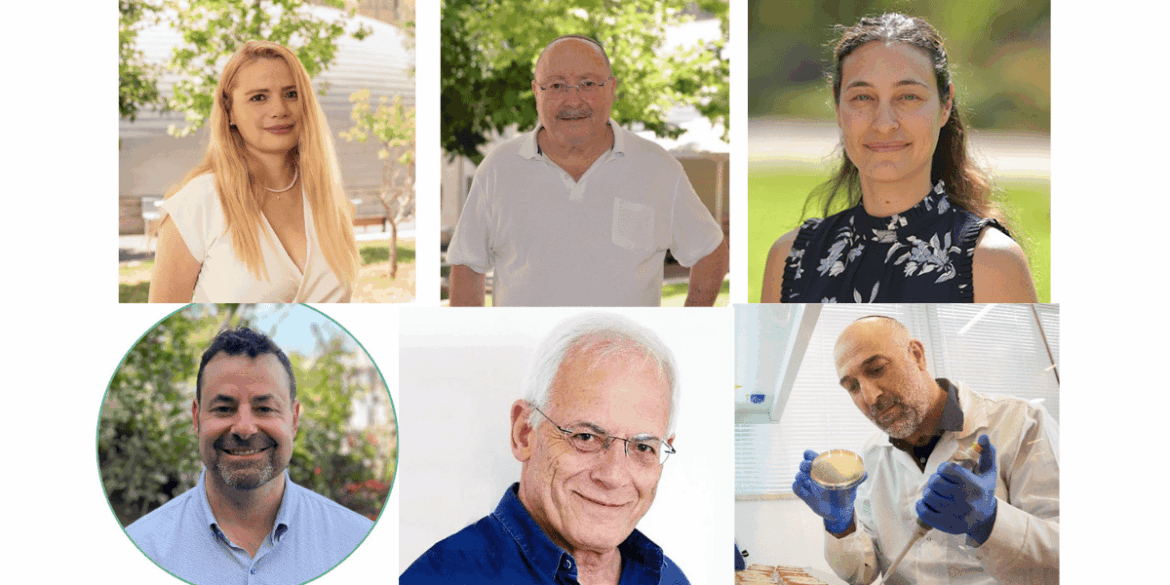
Six researchers from the Hebrew University have been awarded research grants from the Ministry of Innovation, Science and Technology. Each will receive a grant of 500,000 NIS to support research in the fields of medical sciences, mental health, medical imaging, neuroscience, and food science. The grants are awarded through the Office of the Chief Scientist, with the aim of promoting research innovation, scientific excellence, and developments with the potential for clinical and public impact.
Title Image, clockwise from top left: Dr Katy Margulis, Prof Amnon Hoffman, Dr Gali Umschweif-Nevo, Dr Avihu Yona, Prof (Emeritus) Amiram Goldblum, and Prof Adam Rose.
Prof Oron Shagrir, Rector of Hebrew University said: “I congratulate our researchers on this important recognition. Their work exemplifies the Hebrew University’s mission to translate cutting-edge research into practical tools and treatments that address pressing medical and societal challenges, both in Israel and beyond.”
Congratulations to the Grant Recipients:
Dr Avihu Yona, from the Faculty of Agriculture, Food and Environment, was awarded a research grant for the development of an innovative stool based test for diagnosing food intolerances, as an alternative to the breath tests currently in use.
Instead of lengthy breath tests that require patients to visit a clinic and remain under the supervision of qualified medical staff for several hours, the proposed method relies on a single stool sample. The suspected food component is added to the sample, and gas production by gut bacteria is measured. This approach allows multiple substances to be tested simultaneously, without discomfort or prolonged clinic visits, and in a simpler, more accessible, and lower cost manner. The method has the potential to make diagnostic testing for food intolerances more widely available and to streamline current diagnostic practices.
Prof Adam Rose, from the School of Public Health at the Faculty of Medicine, was awarded a research grant for implementing remote compulsory psychiatric assessments in patients’ homes, using telepsychiatry and artificial intelligence. The research was developed in collaboration with Dr Ligat Shalev of Tel Hai College and Dr Renanna Eitan of the Jerusalem Mental Health Center (Kfar Shaul).
The study proposes a new model for assessing patients in psychiatric emergencies before they arrive at the emergency department. When the specialized hospitalization response team arrives at a patient’s home, they will initiate a video consultation with a senior psychiatrist, allowing a determination to be made as to whether immediate hospitalization is required, further evaluation in the emergency department is needed, or the patient can remain at home. In parallel, an artificial intelligence tool will be developed to analyze behavior, facial expressions, and speech patterns, supporting clinical decision-making. This approach is expected to reduce the burden on emergency departments, shorten care pathways, and improve patients’ treatment experience.
Dr Katy Margulis, from the School of Pharmacy, was awarded a research grant for the development of an innovative treatment for acute manic episodes.
The research focuses on developing a new translational approach to treating acute mania, based on understanding disruptions in iron balance in the brain. The study will employ an advanced imaging method, called Desorption Electrospray Ionization Mass Spectrometry Imaging (DESI-MSI), that enables precise mapping of various molecules in the brain during manic states. Integrating these findings will provide deeper insight into brain changes during manic episodes and lay the groundwork for treatments that can be rapidly translated into clinical use.
Dr Gali Umschweif-Nevo and Dr. Raphael Benhamou from the School of Pharmacy, were awarded a research grant for the development of antisense oligonucleotide (ASO) molecules for the treatment of depression and post-traumatic stress disorder (PTSD).
The study focuses on designing antisense oligonucleotides (ASOs) that inhibit Neurensin-2, a newly identified protein discovered by the researchers as a key regulator of stress-related emotional behaviors and the antidepressant response. As part of the project, targeted antisense molecules will be developed to influence brain circuits involved in emotional processing and stress response. This approach is expected to pave the way for more precise and effective treatments for common mental health disorders, with fewer side effects and improved patient suitability.
Prof (Emeritus) Amiram Goldblum and Dr Gali Umschweif-Nevo, from the School of Pharmacy, were awarded a research grant for the discovery of new multi-target molecules for the treatment of depression.
The study proposes an approach in which a single molecule acts simultaneously on several receptors involved in depression, anxiety, and PTSD, rather than relying on a “cocktail” of different medications. To achieve this, the research will use a unique, award-winning computational algorithm developed in Prof. Goldblum’s group, enabling rapid identification of promising models for therapeutic activity. The most promising molecules will first be tested in vitro and subsequently in mouse models, with the goal of advancing a new generation of more effective and precise treatments for mood disorders.
Prof Amnon Hoffman, from the School of Pharmacy, was awarded a research grant for the development of a biodegradable imaging marker for suspicious cancerous lesions in soft tissues such as the breast and gastrointestinal system.
The study will develop a marker detectable by three major imaging modalities—MRI, ultrasound, CT, and mammography—allowing monitoring of suspicious lesions for approximately six months. After this period, the marker will degrade and disappear from the tissue. The grant will support the development of the marker under controlled conditions, testing its safety and effectiveness in animal models, and subsequently evaluating it in women requiring follow-up for suspicious findings in mammography. Successful outcomes are expected to reduce the need for invasive procedures and improve both accuracy and comfort in monitoring suspicious lesions.