
A ‘Legacy of Devotion’ series interview
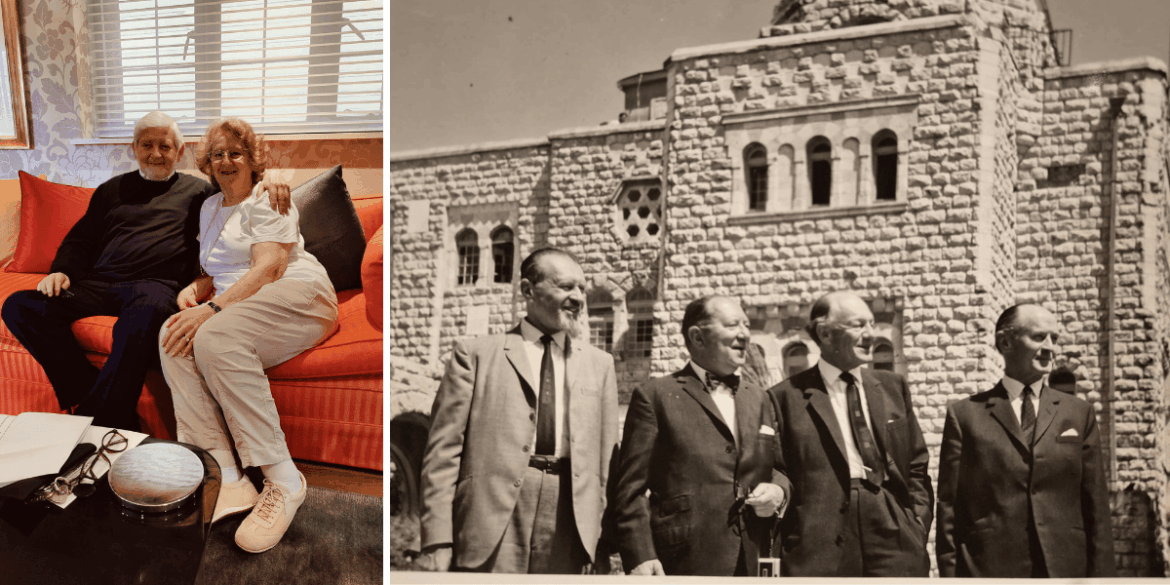
Left image: Shirley and Anthony Spitz Right image: Judge Felix Landau, the honorary Henry Gluckman, Rudy Frankel, Hilliard Leibowitz
Litvaks love a good story, we all know that. And never has that been truer than with the Spitz/Leibowitz families.
Here you have the history of the Leibowitz/Spitz families’ deep relationship with the Hebrew University, told as only a Litvak can tell it – in a series of stories, anecdotes and with a family tree I challenge the best of you to follow.
Beginnings: Lithuanians in South Africa
Anthony and Shirley’s story begins in the Lithuanian shtetls of the early twentieth century, where their respective fathers were both born in 1907, not 10km from each other.
By the time they were 17, the pogroms had left an indelible anxiety in the lives of young Jewish men who survived them but feared being conscripted into the army of the newly independent Lithuania and then disappearing from their families. Young men made plans to leave.
And so, pushed by strife and drawn by the promise of a safer ‘goldene medina’ in the vast South African land where diamonds and gold had recently been discovered in the latter half of the 19th Century, these young people left their homes and families, and immigrated south for the chance of life as traders, pedlars, dreamers.
Shirley’s uncle Morris was the first to land in 1908, followed by his brother Meyer in 1912. Their youngest brother (Shirley’s father) Hilliard arrived in 1925. That same year, Anthony’s father Michael came to join his brother Sam working for their uncle.
The boys worked hard and did well. They settled, married, and built homes in close-knit Jewish neighbourhoods. “Our parents were interchangeable – her parents were like my parents and vice versa,” Anthony recalls, capturing the warmth that defined their families’ unions.
Building a Community, Building the University
All these men were fortunate to have made successes in business.
Proud to be able to support an institution which provided a higher education to young Jewish men and women – an education they themselves had been denied in Eastern Europe – Shirley’s father and uncles became members of the South African Friends of the University:
Shortly after the establishment of the Hebrew University in 1925, Shirley’s uncle Meyer became one of the early members of the board of the South African Friends. Later her dad, Hilliard, became a member, and around 1968 became chairman.
Anthony retells: “Immediately after the end of the Six Day War, once access to Mount Scopus was finally regained, Hilliard, Rudy Frankel, and the Hon Dr Henry Gluckman flew to Jerusalem to attend the awarding of an Honorary Doctorate from the Hebrew University to Itzhak Rabin.”
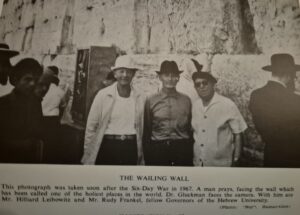
28 June 1967, at the Wailing Wall: Mr Frankel, Mr Leibowitz, Dr Gluckman – Governors of the Hebrew University
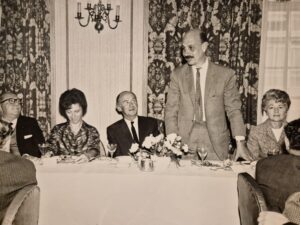
The Hon Henry Gluckman, Carmela Yadin, Hilliard Leibowitz, Yigal Yadin, & Shirley’s mother, Joyce Leibowitz
The Leibowitz family’s dinner table regularly played host to University chancellors and fundraising legends, fostering not just strategic partnerships but friendships and a sense of collective purpose. “As a young married couple, we used to go as well when they used to come to dinner at Shirley’s parents,” Anthony said.
A Tradition Passed Down
In 1978, Shirley’s parents made Aliya. But before leaving they passed the torch: “Her father said to me, ‘You might enjoy getting involved. I think you’ll find it interesting and rewarding.’” Anthony recalls.
Anthony liked the idea and declared his interest to committee members he knew. He was invited to become a member of the S.A. Friends Board, involved in fund-raising around South Africa and frequently attending Board meetings in Jerusalem.
He eventually became chairman of the South African Friends, following judge Richard Goldstone. “It was really lovely for me because it was following on in this family tradition, and we made some of our best friends there!” he notes, proud to have continued a legacy built on connection and a “sense of honour” among South African Jews for helping this advance of Jewish learning.
Meanwhile, Shirley’s memories are as much about values as positions: “It was a background to my life… My Dad and then Anthony worked for the Hebrew University in South Africa, and it was quite a commitment. It was much more than just collecting money. Anthony was involved on many of the international executive committees dealing with issues such as planning and progress.”
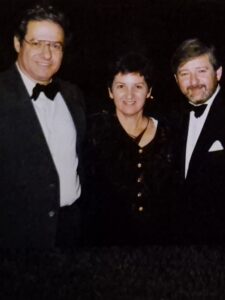
HU President Prof Amnon Pazi, his wife Batya, and Anthony Spitz
Speaking of storied memories, here’s an interesting one:
One day Anthony was summoned from Johannesburg to a modest house on the slopes of Table Mountain to meet an ‘interesting’ man, a Mr Ring. He finds a tiny, austere German Jew with old Bavarian furniture, only five books on his bookshelves (all in German), and not even an offer of tea. The man tells a spare, astonishing life story: arriving in South Africa in 1936 with his parents and disabled sister, working in the family jewellery shop from a young age, then selling everything, after the death of his parents, and quietly investing the proceeds into platinum shares – driven by a solitary obsession with the ozone layer and catalytic converters. Over decades he reinvests every dividend, never marries, and continues his quiet, spartan life.
In pursuit of his obsession with the ozone layer, Mr Ring goes on a tour of Israeli universities. At the first university he visits, he is brusquely dismissed by students who claim to be too busy when he asks to speak with a professor about climate research. But at the Hebrew University a student stops and then personally escorts him to the relevant professor. An instant intellectual “click” forms between him and the University.
Back in South Africa, Anthony enlists his older friend Hans Saenger, a retired German-Jewish businessman, to become executive director of the South African Friends of the Hebrew University and help this “landsman” Ring sort out his philanthropy. Hans flies to Cape Town, and they become close friends.
Years later, upon his death, it emerges that spartan Mr Julius Ring left the Hebrew University 120 million Rand – a staggering sum for the time, and the largest single donation until Lily & Edmond Safra came along.
The saga continues:
The family journey moves from South Africa to the UK – keeping their enduring ties with the Hebrew University. Moving to England in the 1990s, Anthony was quickly welcomed onto the board of the British Friends by peers like Michael Gee and John Sacher. “It was just a lovely extension of our lives,” Anthony says, of meetings and warm reunions with old friends from boardroom circles in Jerusalem, New York, and London.
Some of Shirley’s fond memories come from unexpected sources, like a fundraising dinner at the Victoria and Albert Museum, seated next to a physicist: “What struck me was this man’s imagination and well-roundedness. His humanity. He wasn’t just a physicist… He explained his work to me using everyday examples and metaphors, and it was the most fascinating evening I’d been to. That, to me, is the calibre of people at Hebrew University. They’re more than just their subject matter.”
Their son Derek, recently appointed KC and deeply invested in communal, legal and academic work, now sits on the Board of the British Friends and is a proud Governor of the University – nurturing the next generation’s ties with Israel and the University. “He loves being involved, he’s academic … and so he is the next generation,” Anthony says, with a hope that the fourth will someday step forward too.
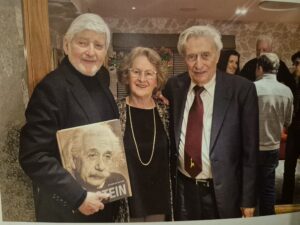
Shirley & Anthony Spitz with HU president Hanoch Gutfreund, at their home in London
Looking Forward
What do they hope for now? That the University continues to foster “fully rounded human beings”, remaining open and pluralistic, with a reputation for forward-thinking, world-changing research and intellectual, ethical, and moral leadership. “Our hope is the family continues to support scholarships for international students, particularly from Africa, who contribute to the communities from which they come,” Shirley says. “It’s not about Nobel Prizes, though they are great, but about going back and sharing what they’ve gained with their communities”.
As the family story continues – Lithuanian roots, South African resilience, international connections, and a deep, enduring link to Hebrew University – it is, above all, a testament to the power of the resilient, globe-spanning Jewish community, a love of learning, and the legacy of giving back.
Wishing the British Friends a very happy 100th birthday!
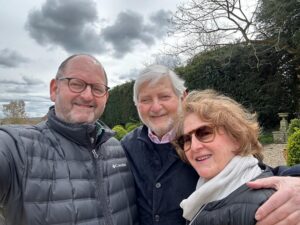
Derek, Anthony and Shirley Spitz