
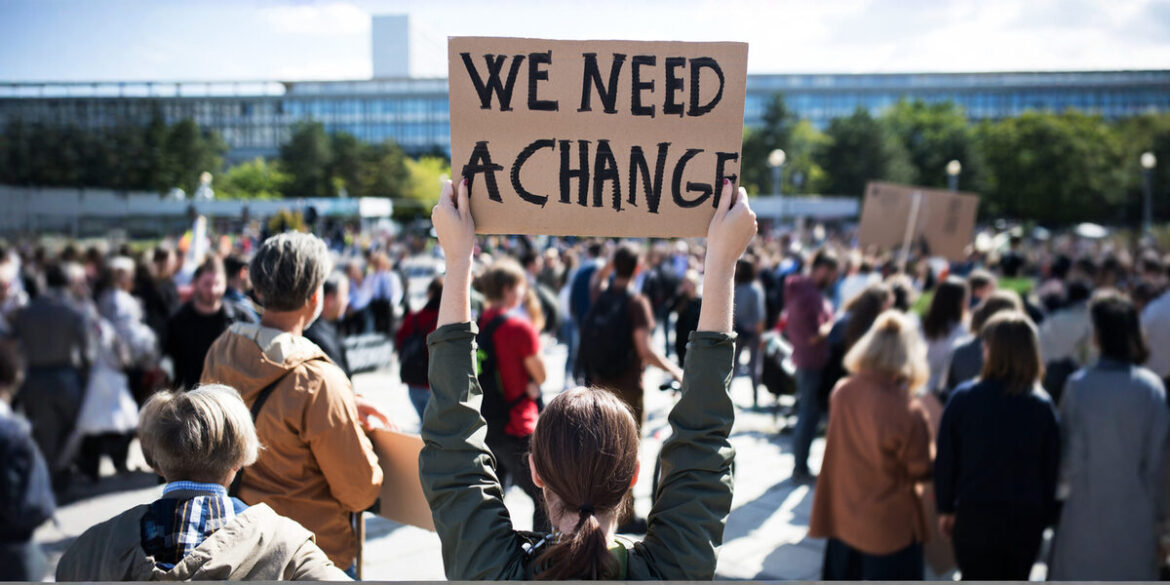
A new study reveals that the image of a seamless global youth climate movement is fracturing as activists in the “periphery” feel increasingly sidelined by a Western-centric leadership. By investigating why these local chapters face a “crisis of connection,” the research exposes how national security threats, democratic backsliding, and political rifts over issues like the Israel-Hamas war are breaking the “weak ties” that once bound the movement together. The study argues that when a global agenda ignores the differing local realities of its members, the human connection often fails long before the digital one.
For years, the image of the youth climate movement was one of seamless global unity, with millions of teenagers from Stockholm to Tel Aviv striking under the same “Fridays for Future” (FFF) banner. However, a new study reveals that beneath the viral hashtags, the movement is facing a “crisis of connection” that has left local chapters in the “periphery” feeling sidelined.
The research, headed by Prof Neta Kligler-Vilenchik, Dganit Levi and Thalia Assan from the Hebrew University of Jerusalem and Prof. Barbara Pfetsch, Zozan Baran and Daniela Stoltenberg from the Freie Universität Berlin, investigates why young activists in Israel and Turkey are increasingly at odds with the global movement’s central leadership. While the global FFF movement, often centered in Western Europe, focuses on universal “climate justice,” activists in the periphery suggest that their local realities are far more complex.
According to the study, published in Information, Communication & Society, these youth feel their activism is hindered by three key factors:
- Democratic Backsliding: Activists in both countries navigate government repression and police violence that their counterparts in “full democracies” rarely encounter.
- Competing National Crises: In Israel, security threats and the Israel-Hamas War often sideline climate issues. In Turkey, activists struggle to obtain permits for protests, as authorities often equate strikes with “riots” or “rebellion”.
- Low Public Awareness: Unlike in Europe, where climate change is a top-tier political issue, Israeli and Turkish youth must battle a significant lack of public and media interest.
In Turkey, friction reached a breaking point in November 2021 when the national chapter formally dissociated from FFF, rebranding as “Turkey for Climate”. This decision followed a heated discussion in international discussion groups where Turkish activists felt mocked and disrespected over their national values.
In Israel, activists have faced intense criticism from the global movement regarding the Israeli-Palestinian conflict. Following the events of October 7, 2023, many Israeli activists felt “pained” by what they perceived as the global movement’s disregard for Israeli casualties and the use of “antisemitic” rhetoric by fellow activists. Despite these tensions, the Israeli chapter chose to remain in the global network to maintain strategic influence, even as their emotional identification with leaders like Greta Thunberg has faded.
“Our research emphasizes the human aspect of connective action,” says Prof Kligler-Vilenchik. While digital tools allow for rapid worldwide mobilization, the study argues that global movements cannot ignore the local, lived experiences of their members. When a “global” agenda clashes with the “local” survival of a chapter, the human connection often breaks long before the digital one.
The research paper titled “‘They don’t like us in the global movement’: the experiences of youth activists at the periphery of worldwide Fridays for Future” is now available in Information, Communication & Society and can be accessed at https://doi.org/10.1080/1369118X.2025.2590166.
Researchers:
Dganit Levi, Zozan Baran, Daniela Stoltenberg, Thalia Thereza Assan, Neta Kligler-Vilenchik, Barbara Pfetsch
Institutions:
- Faculty of Social Sciences, Hebrew University of Jerusalem, Jerusalem, Israel
- Institute for Media and Communication Studies, Freie Universität Berlin, Berlin, Germany
- Child and Youth Rights Program, Minerva Center for Human Rights, Faculty of Law, Hebrew University of Jerusalem, Jerusalem, Israel