
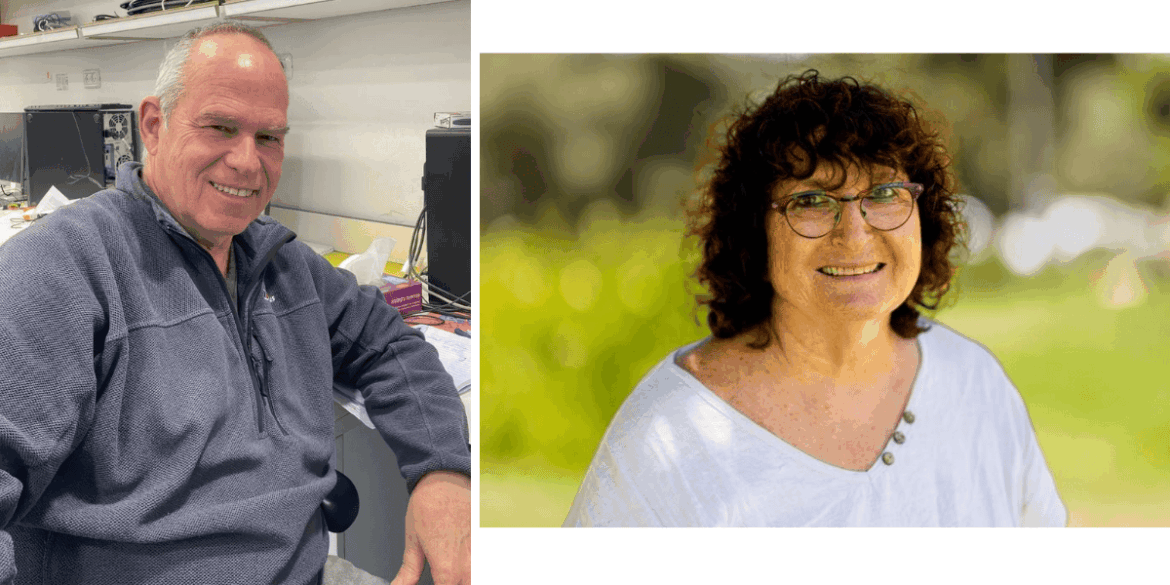
The Hebrew University of Jerusalem congratulates Professors Hanah Margalit and Ilan Rosenshine on their election as Fellows of the European Academy of Microbiology (EAM), a prestigious recognition of scientific excellence and global impact.
The EAM recently elected 95 new Fellows, honoring outstanding contributions across the breadth of microbiology—from fundamental discoveries to innovations addressing global challenges in health, environment, and biotechnology.
title image: Professors Hanah Margalit and Ilan Rosenshine
Prof. Hanah Margalit, a pioneer in computational biology and RNA regulation, and Prof. Ilan Rosenshine, a leader in microbial pathogenesis, have each transformed understanding in their fields. Their election reflects both their scientific leadership and the far-reaching impact of their work.
Professor Hanah Margalit is a pioneer in computational and systems biology, who has made substantial contributions to these fields. Her research focuses on the fundamental principles governing microbial gene expression regulation, particularly the interplay between transcriptional and post-transcriptional control. Her interdisciplinary group has developed cutting-edge methodologies for deciphering and analysis of regulatory networks, leading to scientific breakthroughs. Her key contributions include the development of a genome-based algorithm that enabled the discovery of numerous bacterial small RNAs (sRNAs), and establishment of RIL-seq, a methodology for transcriptome-wide mapping of sRNA-target interactions, revealing sRNA roles in cellular and pathogenic processes. Her work also advanced understanding of sophisticated regulatory circuits and led to uncovering the involvement of microRNAs in viral immune evasion.
Professor Ilan Rosenshine is an internationally recognized leader in microbial pathogenesis, whose work has transformed our understanding of host–pathogen interactions at the molecular level. His early research contributed to the discovery of the first protein tyrosine kinase in bacteria, a breakthrough in bacterial signaling. He later made seminal contributions to the study of pathogenic Escherichia coli, uncovering how the type III secretion system injects effector proteins into host cells to manipulate key signaling pathways. His laboratory has identified critical effectors that inhibit immune responses and developed systems to measure effector injection dynamics, revealing a precise temporal program essential for infection. His discoveries have reshaped central concepts in bacterial virulence and adaptation.
Election to the EAM Fellowship is a prestigious honor, awarded through a rigorous nomination and evaluation process conducted by existing members of the Academy. Fellows are selected for their outstanding scientific achievements and their contributions to advancing microbiology.
Prof. Oron Shagrir, Rector of the Hebrew University, stated:
“We are immensely proud of Professors Margalit and Rosenshine for this well-deserved recognition. Each has reshaped our understanding of microbial life in profoundly different ways, from decoding complex regulatory networks to uncovering the molecular strategies of pathogens. Beyond their scientific breakthroughs, they have built vibrant research communities and trained generations of scientists. Their election to the European Academy of Microbiology is a tribute not only to their individual achievements, but to the spirit of curiosity, rigor, and collaboration that defines the Hebrew University.”
Their work continues to influence fields ranging from infectious disease research to biotechnology and computational biology worldwide.
The Hebrew University celebrates this achievement and looks forward to the continued contributions of its faculty to advancing microbiological research and addressing global scientific challenges.
About the European Academy of Microbiology (EAM)
The European Academy of Microbiology, is part of the Federation of European Microbiological Societies (FEMS) network, and brings together eminent microbiologists whose work has significantly advanced the field. Through the collective expertise of its Fellows, the Academy contributes to scientific dialogue, supports emerging priorities in microbiology, and helps amplify the impact of microbiological research for society.