We are proud to share with our British Friends’ the important work made possible thanks, in part, to your generosity. Through the Hebrew University’s Clinical Legal Education Center, your support helps law students gain vital hands-on experience while ensuring that vulnerable people and communities receive expert legal assistance when they need it most.
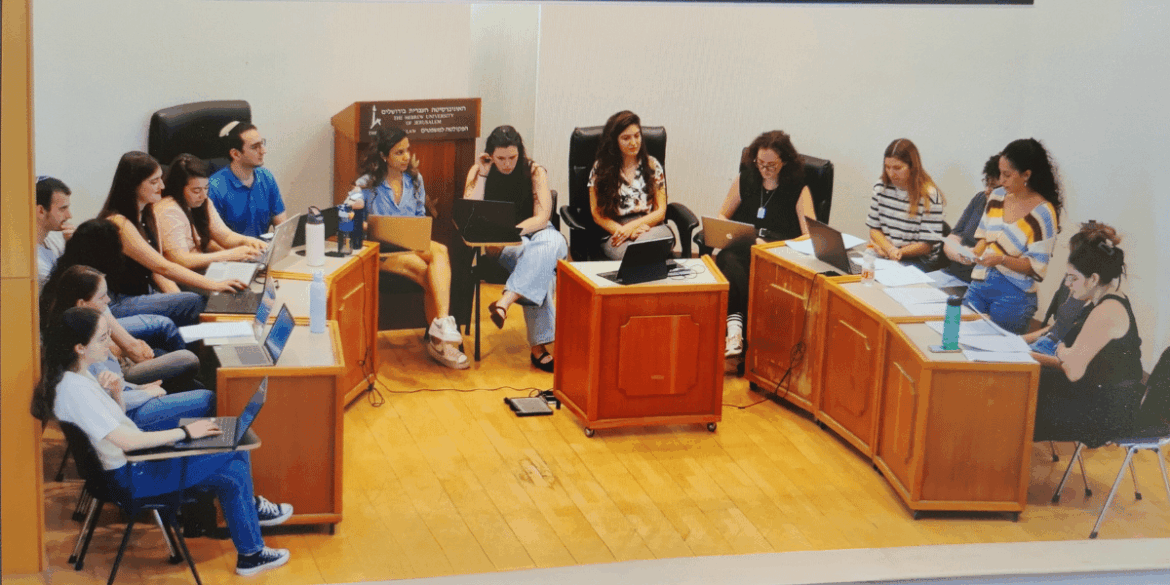
Title image: Moot Courtroom. Faculty of Law, Mount Scopus Campus
This second article in our series focuses on the Clinic for the Representation of Marginalized Population Groups, which works with individuals and communities facing poverty, discrimination, administrative barriers and social exclusion. Its work combines practical legal advocacy with a strong commitment to dignity, access and fairness.
Legal aid with real impact
The Clinic for the Representation of Marginalized Population Groups is one of the CLEC’s central clinics, providing free legal aid, consultation and representation to people in Jerusalem’s marginalized and socioeconomically peripheral communities. At the same time, it gives students the chance to engage directly with real cases, helping them understand how law can be used to protect rights and advance social justice.
The clinic’s work often involves people facing multiple layers of vulnerability. These are clients whose legal problems are closely tied to bereavement, poverty, displacement, discrimination or lack of access to information and support. In this way, the clinic’s interventions can have a profound effect, not only on a single case, but on a person’s ability to regain stability and dignity.
Securing income support for a widow
In one recent case, the Clinic helped a widow secure retroactive income-assurance benefits after her initial claim was denied. Her husband and most of her children were killed in Gaza during the recent war, and she experienced severe mental health deterioration that prevented steady employment. Even so, she continued working part-time as best she could to support her remaining children.
The National Insurance Institute rejected her claim, arguing that she could derive income from family properties in the Palestinian Authority. The Clinic contended that these were inaccessible assets that generated no income and that her share was negligible in any event. After several exchanges, the Institute accepted the argument and approved the claim, including back payments.
This case shows how legal advocacy can help ensure that social rights are applied fairly and with proper regard for a person’s real circumstances.
Standing up for public housing tenants
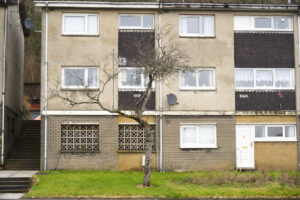
The Clinic also submitted a position paper to the Special Committee overseeing Barrier Removal, chaired by MK Michael Biton, on the rights of public housing tenants in urban renewal projects. The committee is examining the obstacles faced by public housing residents and the protections they are entitled to in large-scale redevelopment schemes.
The Clinic stressed that it is not enough to condition approval of urban renewal projects on a meaningful share of public housing units. It is also essential to define and publicly articulate the rights of public housing tenants within such projects. The paper called for transparency and fair dealing obligations on the part of developers and housing companies, noting that these residents are especially vulnerable because they have no ownership rights, no organised voice and limited protection in the process.
This work demonstrates the clinic’s broader contribution: not only helping individual clients, but also pushing for structural change that can better protect vulnerable communities in the future.
Correcting unfair tax decisions
Another important case involved 12 residents of East Jerusalem whose applications for municipal property tax reductions were arbitrarily rejected. The municipality had dismissed their requests on the vague ground that “documents were not provided,” without specifying what was missing or giving the applicants a chance to correct the issue.
The Clinic submitted a request for renewed review, highlighting the serious administrative flaw in rejecting a request without a detailed, reasoned explanation and without allowing a technical deficiency to be corrected. This kind of procedure effectively denies residents the ability to exercise a social right to which they may be entitled.
About a month later, the municipality informed the Clinic that the residents would be allowed to reapply and that their eligibility would be reconsidered. This outcome shows how important due process is, particularly where access to essential support is at stake.
Why this work matters
The Clinic for the Representation of Marginalized Population Groups demonstrates the power of legal advocacy to open doors that might otherwise remain closed. Its work helps individuals secure benefits, challenge unfair decisions and assert rights that are essential to daily life.
These cases are a powerful reminder of the real impact on the wider community achieved by supporting the University. Through the CLEC, your generosity helps ensure that Hebrew University students are trained not only as excellent lawyers, but as professionals who understand the importance of fairness, responsibility and service.
This clinic’s work also reflects the broader mission of the Clinical Legal Education Center: to combine education with meaningful social impact. By supporting vulnerable clients and challenging systemic barriers, it is helping build a more just and inclusive society.
Looking ahead
This series will continue to highlight the different clinics within the Clinical Legal Education Center, each of which addresses a different area of need. The Clinic for the Representation of Marginalized Population Groups is a strong example of how legal expertise, compassion and persistence can transform lives.