
A new study shows that preloading plant-derived cellulose scaffolds with growth factors can support the cost-efficient growth and differentiation of bovine stem cells for cultivated meat. By attaching these essential proteins directly to an anisotropic, directionally frozen framework rather than dispersing them throughout liquid media, the method achieves strong tissue development while using up to ten times fewer of the expensive factors. After several weeks of cultivation and pan-frying, the cell-grown constructs showed some similarities in texture and appearance to traditional sirloin cuts.
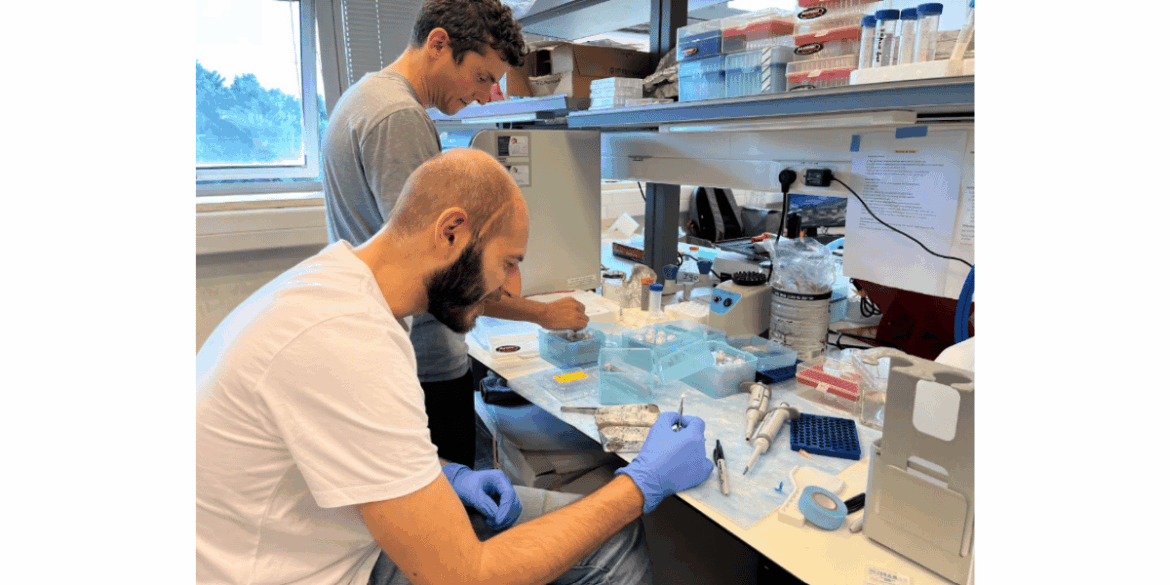
Title image: Alon and Jo “cooking” CNC scaffolds Description- the two first authors are examining different CNC concentrations while developing the exact method to prepare the CNC scaffolds. (2022) Credit- Sharo Schlesinger
Researchers at the Hebrew University of Jerusalem have developed a novel approach that could significantly reduce the production costs of cultivated meat. The study, co-authored by Alon Gershkoviz, Joseph Kippen and Yael Gilad, and co-mentored by Prof Oded Shoseyov and Dr Sharon Schlesinger from the Faculty of Agriculture, in collaboration with Prof Ido Braslavaski, also from the faculty, presents a food-safe cellulose-based scaffold that sharply lowers the amount of expensive growth factors needed to develop structured meat products such as steaks.
Cultivated meat has long been promoted as an ethical and environmentally friendly alternative to conventional agriculture, but the commercial production of structured whole cuts has been limited by technical challenges and high media costs. Growth factors, which stimulate cell multiplication and differentiation, typically account for more than 95 per cent of these expenses. By embedding these proteins directly into a specialised porous scaffold, rather than continuously dissolving them in liquid culture media, the researchers achieved comparable cell growth using up to ten times less of these costly factors.
The scaffold itself is created using directional freezing techniques applied to combinations of nano- and microcrystalline cellulose derivatives. This process produces aligned, tunnel-like microstructures that mimic the extracellular matrix of animal muscle tissue. Bovine mesenchymal stem cells seeded onto these structured platforms showed strong adhesion, long-term survival and parallel alignment as they grew along the cellulose fibres.
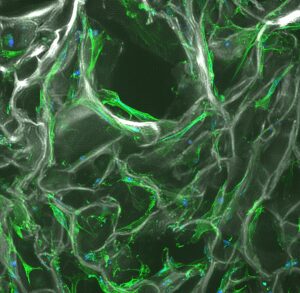
The anisotropic scaffold does more than simply support the cells: it actively encourages them to develop towards a muscle lineage. Over the course of several weeks, the cells differentiated and accumulated cytoplasmic lipids and structural muscle proteins such as titin. This biological maturation altered the physical properties of the constructs, increasing their stiffness and compressive strength to levels that closely resemble those of raw sirloin.
The culinary potential of the cultivated constructs was then tested through standard cooking trials. When pan-fried at high temperatures, they retained their shape and developed the familiar browning associated with the Maillard reaction. Mechanical testing after cooking showed that the fried cultivated cuts had a fibrous, tissue-like texture and a resistance to compression similar to that of conventional fried beef.
“Our findings demonstrate that we can radically change the economics of cellular agriculture without sacrificing tissue quality,” said Dr Sharon Schlesinger. “By pinning the growth factors directly to the scaffold, the cells get immediate access to the signals they need to thrive. This allows us to cut resource waste by an order of magnitude and brings us a substantial step closer to a scalable, commercially viable alternative to industrial meat production.”
Prof Oded Shoseyov added: “Using plant-derived materials like cellulose allows us to build a highly structured, sustainable framework that naturally guides stem cells into replicating real meat architectures. Seeing the final product respond to frying with the same browning and structural density as a traditional steak confirms that this bioengineering approach can deliver the authentic sensory experience consumers expect.”
While the findings are still a proof of concept, the researchers say the next steps will be to move towards fully serum-free formulations and to scale up production to commercial standards. Even so, the combination of low-cost agricultural materials and innovative biochemistry marks an important milestone for cellular agriculture in Israel and beyond.
Myogenic differentiation on scaffold Description– cells were differentiated for 21days and stained for the cellulose scaffold (white), nucleic acid (blue) and the myogenic protein Titin (Green)
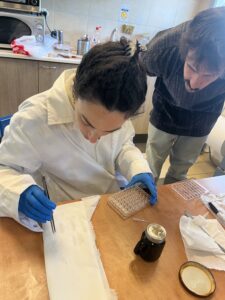
Left: Yael and Adar are preparing the scaffold fo…ied sirloin steak. Credit- Sharon Schlesinger.
Right: Jo is making a batch of small scaffolds to examine the GFI-scaffolds Description- Because scaffold preparation can vary and introduce technical diversity, whenever we designed a large experiment to compare several variables, the students created a very large cohort of scaffolds that were used in triplicate or sixfold for that experiment. Here we see Jo before the most significant experiment, the one that demonstrated the GFI scaffold’s remarkable ability to maintain cell proliferation without the need for continuous addition of the GF. Credit- Sharon Schlesinger
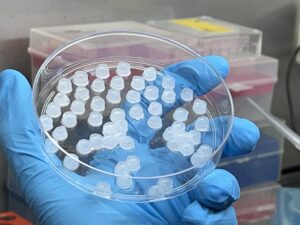
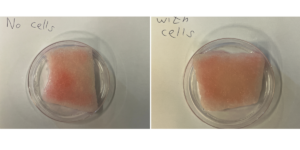
Left: Large CNC scaffolds without cells Description- scaffolds were soaked in media and maintained in 37c for 2 weeks Credit- Sharo Schlesinger
Right: Large CNC scaffolds with cells; Description- bovine MSC-seeded scaffolds were cultured in 37c for 2 weeks, proliferation analysis showed >70 cell coverage, proving the scaffold support viability and proliferation Credit- Sharo Schlesin
The research paper titled “Growth factors-infused cellulose scaffolds support cost-efficient proliferation and differentiation of bovine stem cells for cultivated meat” is now available in Current Research in Food Science and can be accessed at https://doi.org/10.1016/j.crfs.2026.101430.
Researchers:
Alon Gershkoviz, Joseph Kippen, Yael Gilad, Ivana Ribarski-Chorev, Eran Lavi, Itai Rotem, Einat Zelinger, Ido Braslavsky, Oded Shoseyov, Sharon Schlesinger
Institutions:
- Department of Animal Sciences, The Robert H. Smith Faculty of Agriculture, Food and Environment, The Hebrew University of Jerusalem, Rehovot, 7610001, Israel
- Department of Plant Sciences, The Robert H. Smith Faculty of Agriculture, Food and Environment, The Hebrew University of Jerusalem, Rehovot, 7610001, Israel
- Microscopy unit, Center for Scientific Imaging, The Robert H. Smith Faculty of Agriculture, Food and Environment, The Hebrew University of Jerusalem, Rehovot, 7610001, Israel
- Institute of Biochemistry, Food Science, and Nutrition, Robert H. Smith Faculty of Agriculture, Food, and Environment, The Hebrew University of Jerusalem, Rehovot, 7610001, Israel