
Researchers discover that tiny atmospheric particles can have opposite effects on Earth’s climate depending on how quickly the atmosphere responds. Why it matters: Aerosols are one of the largest sources of uncertainty in climate projections. This study shows that their impact can change over time, initially warming the atmosphere before later cooling it. The findings could help scientists improve climate models and make more accurate predictions of future climate change.
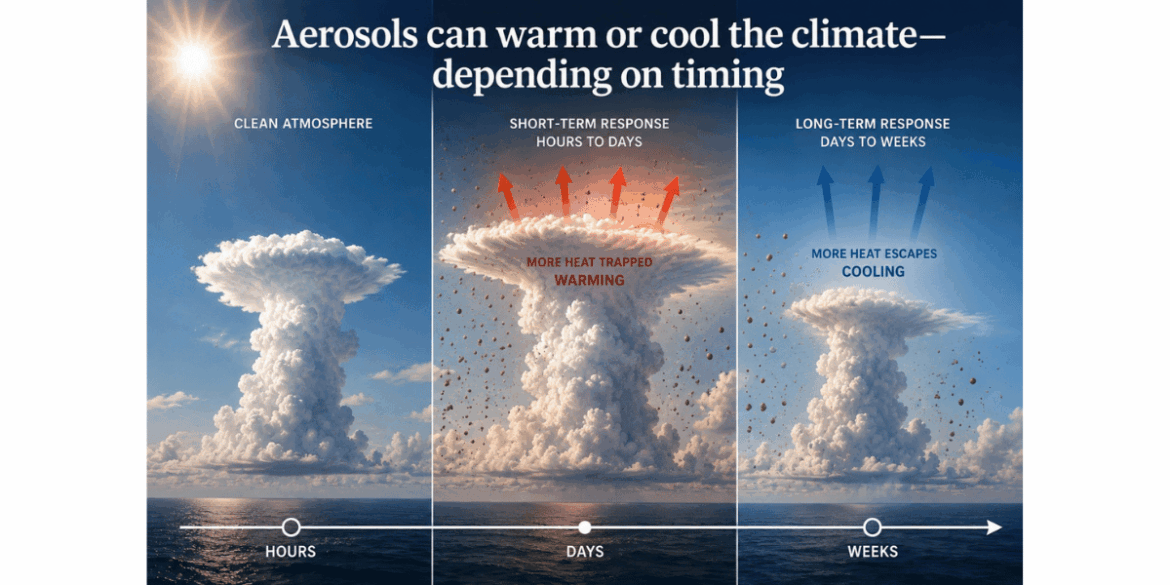
Title image: Illustration of aerosol-cloud interactions and their changing effects on Earth’s climate over time. Credit: Hebrew University of Jerusalem / AI-generated illustration
A new study from the Hebrew University of Jerusalem challenges a long-held assumption in climate science by showing that aerosols—tiny particles suspended in the atmosphere—can either warm or cool the climate depending on the timescale considered.
Led by Prof Guy Dagan of the Fredy and Nadine Herrmann Institute of Earth Sciences, the research reveals that aerosol-cloud interactions can produce opposite climate effects in the short term and long term. The findings, published in Nature Communications, offer a new explanation for why aerosols remain one of the largest sources of uncertainty in climate projections.
Aerosols come from a variety of natural and human-made sources, including air pollution, wildfires, sea spray, and dust. Scientists have long known that these particles influence how clouds form and how much heat the Earth retains, but accurately estimating their overall impact on climate has proven difficult.
Using advanced computer simulations, Prof Dagan examined how clouds respond after a sudden increase in aerosol concentrations and how those responses evolve over time. The results revealed a surprising pattern.
During the first two days after aerosol levels increase, the atmosphere experiences a net warming effect. Changes in cloud processes lead to the formation of more high-altitude clouds, which trap additional heat that would otherwise escape into space.
Over time, however, the atmosphere adjusts. As upper layers of the atmosphere warm, cloud development changes, allowing more heat to escape. The initial warming effect gradually gives way to an overall cooling effect.
The study found that the balance between these competing effects depends on two key factors: how quickly aerosol concentrations change and how quickly the atmosphere responds. When aerosol levels fluctuate rapidly, short-term warming effects can dominate. When changes occur more gradually, the longer-term cooling response becomes more important.
The researchers also identified evidence of what scientists call “atmospheric memory.” In some cases, the climate effect of aerosols depends not only on current aerosol levels but also on whether those levels have recently been increasing or decreasing. As a result, the same amount of aerosols can produce different climate effects under different circumstances.
According to Prof Dagan, the findings have important implications for both climate observations and climate modeling.
“Much of what we know about aerosol-cloud interactions comes from observing the atmosphere at a single moment in time,” said Prof. Dagan. “Our results show that the atmosphere has a memory. The climatic impact of aerosols depends not only on how many particles are present, but also on how rapidly conditions are changing and how much time the atmosphere has had to respond. Accounting for these timescales could help reduce one of the largest sources of uncertainty in climate projections.”
The findings suggest that scientists should pay closer attention to how atmospheric conditions evolve over days rather than relying solely on isolated observations. Incorporating these time-dependent processes into climate models could improve estimates of aerosol-driven climate effects and lead to more accurate projections of future climate change.
Media Contacts:
Dr. Guy Dagan
Fredy and Nadine Herrmann Institute of Earth Sciences, Hebrew University of Jerusalem
Email: guy.dagan@mail.huji.ac.il
Research Paper
Dagan, G. Opposing transient and equilibrium effective radiative forcing from aerosol-cloud interactions. Nature Communications (2026). DOI: https://doi.org/10.1038/s41467-026-72896-6
Author: Guy Dagan Affiliation: Fredy and Nadine Herrmann Institute of Earth Sciences, Hebrew University of Jerusalem, Israel