
This study investigates how hunter-gatherer populations in the southern Caucasus survived and adapted between 57,000 and 27,000 years ago. Drawing on archaeological, geological, and environmental, evidence, the researchers reconstructed patterns of mobility, population density, and social interaction across a vast and environmentally diverse region. Uniquely, the study moves beyond the traditional focus on climate and stone tools to examine how social networks functioned as a survival strategy. The findings reveal that despite living in small prehistoric communities, dispersed populations, maintained long-distance connections through the exchange of knowledge, technology, and social ties—networks that may have been just as important as environmental adaptation in helping people endure periods of profound change.
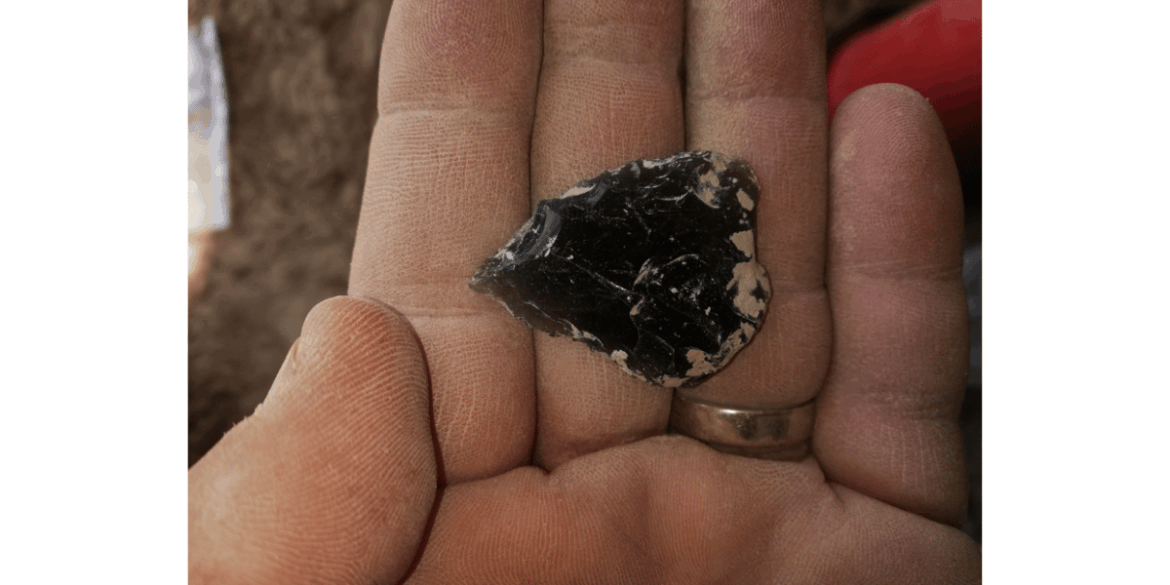
Title image: Obsidian convergent scraper discovered at Ararat-1 Cave, Armenia. Description: Similar stone-tool technologies found across the region suggest that prehistoric hunter-gatherers maintained extensive networks of knowledge exchange despite living in small, dispersed populations. Credit: Ariel Malinsky-Buller
A new study led by Dr Ariel Malinsky-Buller of the Hebrew University of Jerusalem challenges long-held assumptions about how prehistoric hunter-gatherers survived in the Southern Caucasus between 57,000 and 27,000 years ago. Rather than relying on environmental adaptation alone, the research suggests that extensive social networks, long-distance mobility, and the exchange of knowledge were critical to human resilience during periods of climatic and ecological change.
Published in Quaternary Science Reviews, the study combines archaeological, geological, and paleoenvironmental evidence to reconstruct how small, dispersed populations navigated a challenging and highly diverse landscape spanning present-day Armenia, Georgia, and neighboring regions.
The findings reveal a surprising paradox: although populations were relatively small and sparsely distributed, they were far from isolated. Evidence from stone tools and obsidian artifacts shows that people routinely travelled between 40 and 200 kilometers, maintaining connections across vast territories. Similar technological traditions found across the Southern Caucasus and Armenian Highlands further suggest that prehistoric communities exchanged knowledge and maintained social ties over long distances.
The research offers a new perspective on one of the most important periods in human prehistory—the transition from the Middle Paleolithic to the Upper Paleolithic. Rather than a rapid replacement of one population or culture by another, the evidence points to a more gradual process in which different cultural traditions coexisted and interacted for thousands of years.
By placing social connectivity at the center of prehistoric survival, the study advances a new framework for understanding human adaptation. The researchers argue that mobility, environmental conditions, population size, and social networks must be considered together when reconstructing how ancient communities responded to uncertainty and change.
“Our findings suggest that mobility alone does not tell the full story of prehistoric survival,” said Dr Ariel Malinsky-Buller. “Even in regions with small and dispersed populations, people remained connected through networks of knowledge, technology, and social interaction. These connections may have been just as important as environmental adaptation in helping communities endure periods of profound change.”
Key findings
- Small populations, large networks: Even low-density hunter-gatherer groups maintained extensive social connections across the region.
- Unexpected mobility: People routinely traveled distances of 40–200 kilometers, far exceeding predictions of traditional settlement models.
- Knowledge as a survival tool: Shared technologies and cultural practices suggest active exchange of information across communities.
- A more complex prehistoric transition: The shift from the Middle to Upper Paleolithic appears to have involved long periods of coexistence rather than abrupt cultural replacement.
- A new model of resilience: Social connectivity may have been as important as environmental adaptation in helping prehistoric populations survive.
The study was conducted by an international team of researchers from the Hebrew University of Jerusalem, the National Academy of Sciences of Armenia, Yerevan University, the University of Castilla-La Mancha, the University of Algarve, the American School of Classical Studies at Athens, the University of Seville, the University of California Berkeley, Yale University, the University of Liverpool, the Technical University Bergakademie Freiberg, and the Royal Holloway University of London.
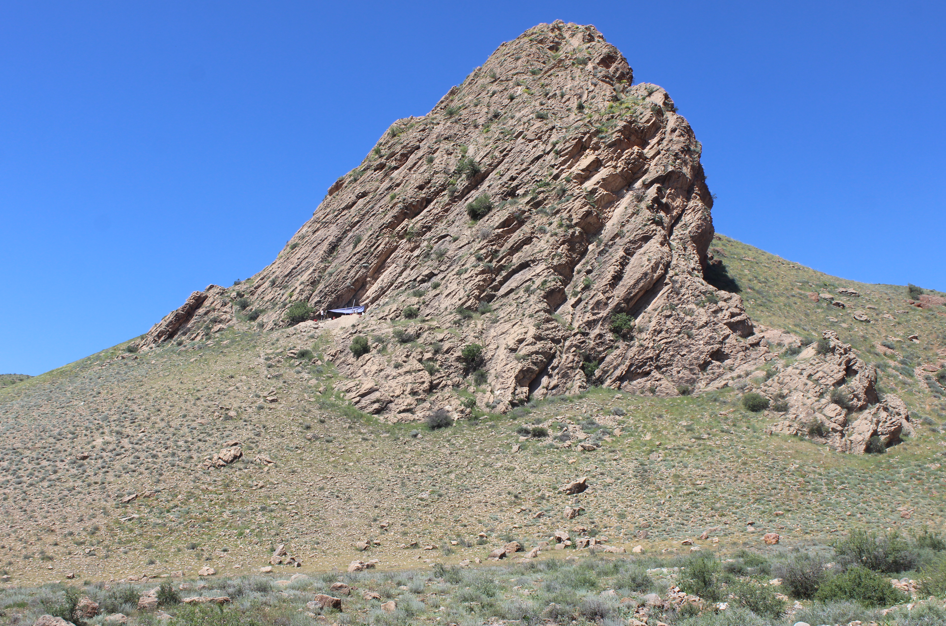
Ararat-1 Cave, Armenia. Excavations at the site have uncovered evidence of long-distance mobility and shared technological traditions, helping researchers trace the social networks that connected prehistoric hunter-gatherer communities across the southern Caucasus. Credit: Ariel Malinsky-Buller
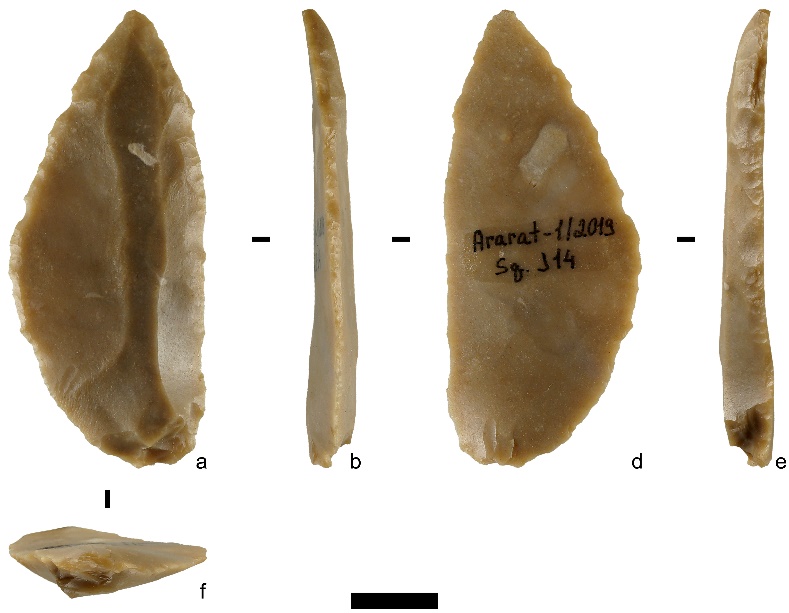
Flint convergent scraper from Ararat-1 Cave, Armenia, shown from multiple angles. Description: The carefully shaped working edge reflects sophisticated stone-tool production techniques used by prehistoric hunter-gatherers in the southern Caucasus. Artifacts such as this help researchers trace technological traditions and connections between communities across the region. Credit: Boris Gasparyan
The study appears in a special issue of Quaternary Science Reviews edited by Dr. Ariel Malinsky-Buller and Prof. Erella Hovers of the Hebrew University’s Institute of Archaeology. The volume brings together findings from four excavation seasons at prehistoric sites in Armenia, offering new insights into how hunter-gatherers adapted to the southern Caucasus over the past 300,000 years. Combining archaeological, geological, and environmental evidence, the studies highlight the region’s importance for understanding human evolution, showing how climate change, mobility, technology, and social networks shaped prehistoric lifeways across Eurasia. Link: https://www.sciencedirect.com/special-issue/10TG1B508KW
The research paper titled “Investigating population dynamics in the Southern Caucasus: Current progress and future steps” is now available in Quaternary Science Reviews and can be accessed at http://doi.org/10.1016/j.quascirev.2026.109877https://www.sciencedirect.com/special-issue/10TG1B508KW
Researchers:
A. Malinsky-Buller, T. Karampaglidis, D. Nora, I.A.K. Oikonomou, D. Rogall, L. S´anchez-Romero, E. Frahm, K. Fenn, H. Gevorgyan, S.P.E. Blockley , A. Petrosyan
Institutions:
- Human-Environment Dynamics Laboratory (HUMENDY), Institute of Archaeology, The Hebrew University of Jerusalem, Jerusalem, Israel
- Department of Geological and Mining Engineering, University of Castilla-La Mancha, Toledo, Spain
- ICArEHB, Interdisciplinary Center for Archaeology and Evolution Human Behavior, University of Algarve, Campus de Gambelas, 8005-139, Faro, Portugal
- Malcolm H. Wiener Laboratory for Archaeological Science, American School of Classical Studies at Athens, 106 76, Athens, Greece
- Departamento de Prehistoria y Arqueología, Facultad de Geografía e Historia, University of Seville, Seville, 41004, Spain
- HUM1089-PAMSUR Group, University of Seville, Seville, Spain
- Human Evolution Research Center, University of California, 3101 Valley Life Sciences Building, Berkeley, CA, 94720, USA
- Department of Anthropology & Council on Archaeological Studies, Yale University, New Haven, CT, USA
- Department of Geography and Planning, University of Liverpool, Liverpool, UK
- Institut für Geologie, Technische Universität Bergakademie Freiberg, Bernhard-von-Cotta-Straße 2, 09599, Freiberg, Germany
- Institute of Geological Sciences of the National Academy of Sciences of the Republic of Armenia, Yerevan, Armenia
- Centre for Quaternary Research, Department of Geography, Royal Holloway, University of London, Egham, Surrey, UK
- Institute of Archaeology and Ethnography, National Academy of Sciences of Armenia, Yerevan, Armenia