
What if the plants growing in a field could one day produce the same proteins that give milk its nutrition, texture, and cheese-making properties? A new study brings that possibility a step closer by revealing an unexpected way plant seeds can manufacture and store one of milk’s most important proteins. The discovery could help overcome a major hurdle in producing real dairy proteins without cows, paving the way for more sustainable dairy ingredients and alternative food production.
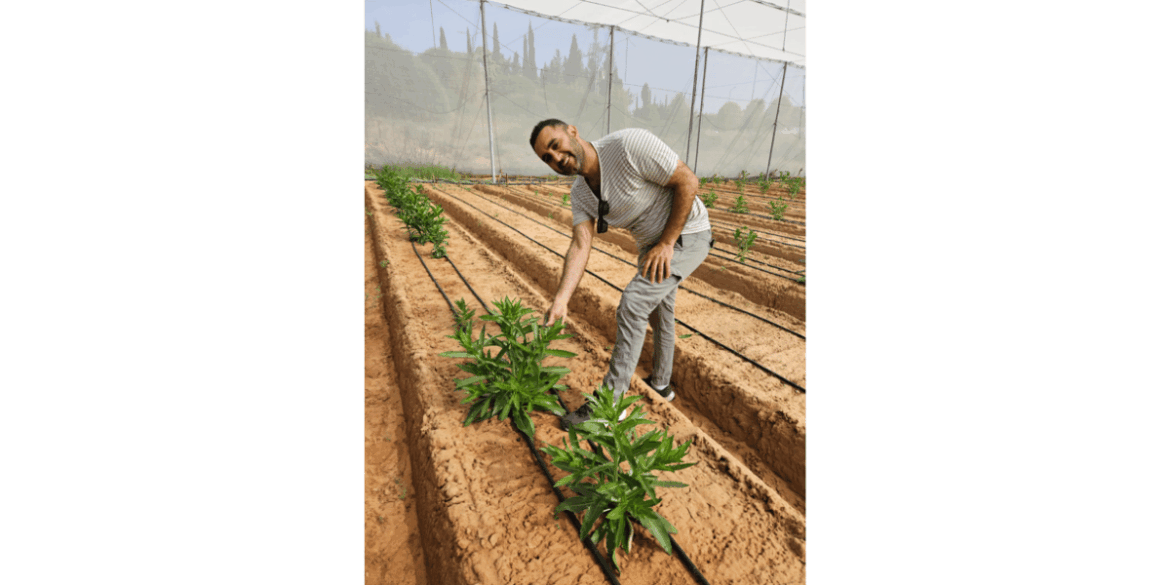
Almog Ozeri with the Safflower plants. The future of dairy proteins| Credit: Mai Shamir
What if the key ingredient that gives milk its nutritional value, creamy texture, and cheese-making ability could be grown inside plants instead of produced by cows?
Researchers at the Hebrew University of Jerusalem have taken an important step toward that goal. In a new study published in Frontiers in Plant Science, they demonstrated that plants can successfully manufacture β-casein—one of the major proteins found in cow’s milk. Even more surprising, the protein accumulated in an entirely unexpected location inside plant cells, revealing a previously unknown pathway that could help improve the production of animal proteins in crops.
The research was led by Prof Oded Shoseyov of the Robert H. Smith Faculty of Agriculture, Food and Environment at the Hebrew University of Jerusalem, together with lead author Almog Ozeri, Mai Shamir, Miron Abramson, Barak Cohen, Amir Rudich, in collaboration with Miruku, a New Zealand based company.
As global demand for dairy continues to grow while concerns mount over greenhouse gas emissions, land use, and water consumption associated with livestock farming, scientists have been searching for sustainable ways to produce authentic dairy proteins without relying on animals. Plant molecular farming, using crops as miniature protein factories, has emerged as one of the most promising approaches, but producing complex milk proteins in plants has remained a major technical challenge.
To tackle this problem, the researchers engineered Arabidopsis seeds to produce bovine β-casein fused to a small portion plant oil-body protein called oleosin which is bound to plant oil bodies. They tested several different “cellular addresses,” directing the protein to various compartments within the plant cell to determine where it would accumulate most efficiently.
The team expected the protein to build up inside specialized storage vacuoles. Instead, advanced electron microscopy revealed something entirely different.
Rather than ending up in the intended storage compartment, the milk protein formed previously unrecognized protein-rich structures which looks like natural casein protein micelles, closely associated with tiny oil bodies inside the seed cells. These unexpected protein-oil aggregates accumulated successfully while maintaining healthy seed germination, suggesting that plants may possess an alternative route for storing complex recombinant proteins.
The best-performing plants produced β-casein at levels of approximately 1.26% of total soluble seed protein, substantially higher than many previous reports of casein production in plants, demonstrating the potential of the new strategy.
“One of the most exciting aspects of science is when nature surprises you,” said Prof Oded Shoseyov. “We set out to send the protein to one location inside the cell, but instead discovered that the plant had effectively created its own storage solution. Understanding this unexpected behaviour gives us valuable insight into how plants handle complex proteins and may help us engineer more efficient systems for producing sustainable dairy proteins in the future.”
Beyond dairy alternatives, the findings could have broad implications for plant molecular farming, a rapidly growing field that uses crops to manufacture high-value proteins for food, nutrition, and even medicine. By understanding where and why recombinant proteins naturally accumulate they may be able to design plants that produce higher yields while simplifying purification and reducing production costs.
As demand grows for environmentally sustainable sources of protein, discoveries like this bring scientists closer to producing authentic dairy ingredients in plants that require only sunlight, water, and soil to grow.
Recently the scientists managed to transform Safflower plants with the dairy proteins, advancing the technology beyond Arabidopsis model plants. Safflower, is an ideal oil-seed plant, due to its ability to grow in hot climate, and arid land thus making it ideal crop for global worming and growing demand for nutritional proteins
Title: Microscope Reveals Surprising Milk Protein Clusters in Engineered Seeds; Credit: Dr. Yael Friedman
Caption: Transmission electron microscopy (TEM) of engineered seed cells reveals that, instead of reaching its intended storage compartment, the milk protein formed previously unrecognized structures resembling natural casein micelles clustered near tiny oil bodies. Using gold nanoparticle labeling, researchers captured these novel, protein-rich clusters-visible as distinct dark circles-under high magnification to map their unexpected cellular location
Title: Illustration Comparing Normal and Genetically Modified Plant Seed Cells. Credit: Almog Ozeri
Caption: A comparison between normal and genetically modified plant cells illustrates how introducing milk proteins alters internal storage, prompting tiny oil bodies to fuse into large, distorted structures at the cell’s periphery. Remarkably, these unusual protein-oil aggregates accumulate successfully without affecting seed germination, suggesting that plants possess an alternative, highly resilient route for storing complex animal proteins.
Research Paper
Ozeri, A., M. Shamir, M. Abramson, B. Cohen, A. Rudich, N. Lugassi, and O. Shoseyov. 2026. “Subcellular Localization of C-term-Oleosin Fused to β-Casein Reveals Unexpected Cytoplasmic Accumulation in Vacuole-Targeted Arabidopsis Seeds.” Frontiers in Plant Science 17:1872014 (2026). DOI: https://doi.org/10.3389/fpls.2026.1872014
Authors:
Almog Ozeri | Mai Shamir | Miron Abramson | Barak Cohen | Amir Rudich | Nitsan Lugassi | Oded Shoseyov
Affiliations:
- Robert H. Smith Faculty of Agriculture, Food and Environment, The Hebrew University of Jerusalem, Rehovot, Israel
- Miruku Ltd., Rehovot, Israel
- GeneNeer Ltd., Ness Ziona, Israel