
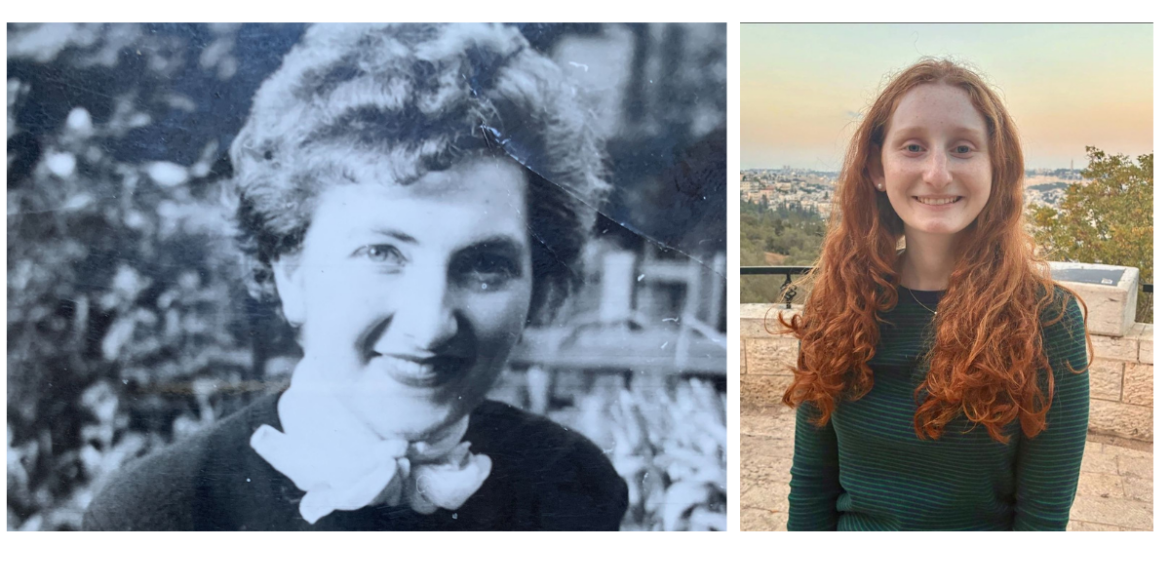
The inaugural Max Shayngesicht Prize in English Poetry has brought together memory, literary craft and living testimony in a way that feels both profoundly moving and perfectly timed. Established by Betty Shane z”l in memory of her father, Max Shayngesicht, who perished in the Holocaust, the prize is a testament not only to loss but to the enduring power of words to carry meaning across generations.
This year, that legacy found its first expression in Temima Weissmann’s prize-winning poem, The Poet of Auschwitz, a work of striking restraint and emotional precision. Announced in the Hebrew University of Jerusalem’s centenary year, the award feels especially resonant: a new beginning rooted in remembrance, and a fitting tribute to a family who chose to turn mourning into something creative, generous and lasting.
Betty Shane herself was deeply shaped by learning and language. A trained teacher, she taught for 22 years before retiring in the 1990s, and poetry remained a lifelong love. Her generous gift to the University, made through her will to British Friends of the Hebrew University, established the Max Shayngesicht Prize as a living memorial to both her father and her own devotion to literature. In doing so, she ensured that his name would be honoured not only in remembrance, but in the encouragement of new poetic voices.
That spirit of continuity is at the heart of the prize. There will, in fact, be two annual awards: one for a poet living in Israel and another for a poet who has translated poetry from a foreign language into English. The first prize has now been awarded to Temima, whose poem speaks with remarkable delicacy about what can and cannot be known of the Holocaust, and about the act of writing itself as a form of survival.
In conversation about the poem, Temima reflected on how unusual and meaningful it felt to be recognised by a prize that gives English-language poets in Israel a distinct platform. She noted that such a space is especially important for writers whose work draws on Jewish themes, memories and seasonal rhythms that may not always be easily understood elsewhere. For her, the prize offered something rare: the chance to write from a place of cultural specificity without having to dilute or explain away what makes the work deeply rooted and personal.
That connection between personal identity and poetic expression runs through The Poet of Auschwitz. Temima first wrote the poem in 11th grade, during the period of Yom HaShoah, when she was thinking about the many survivors who went on to write books, poems and memoirs, and about the far greater number of voices that were silenced forever. She wanted, she said, to imagine the unrecorded testimony of those who perished, and to honour the stories, metaphors and words they might have left behind.
The result is a poem that approaches its subject with humility. Temima was careful not to presume too much, choosing instead to leave space, silence and distance in the work. That restraint gives the poem its force. It does not try to explain the Holocaust; rather, it acknowledges the limits of representation and the ethical responsibility of writing about suffering with care. The anonymous figure at its centre becomes at once a single poet and a symbol of countless others whose voices were lost.
There is, Temima suggested, something deeply respectful in that distance. The poem resists voyeurism and refuses to turn atrocity into spectacle. Instead, it allows the reader to glimpse only what is possible: the effort of expression, the fragility of memory, the stubborn persistence of art even in the most extreme conditions. In that sense, the poem itself becomes a quiet act of witness.
What makes the prize especially powerful is the way it links this act of witness to Betty Shane’s own values. A teacher by profession and a lover of poetry by inclination, Betty believed in the transformative power of education and in the importance of sustaining the arts. The prize created in her father’s memory is therefore also a reflection of her own life: thoughtful, committed and generous in spirit.
For Temima, who never met Betty but feels a kinship with her through a shared love of poetry, the connection is especially moving. “Whenever I meet someone who loves poetry just like me, I feel a special connection,” she said. “We see the world in the same way.” That sense of shared vision gives the prize an intimacy that goes beyond the formalities of an award. It feels like a meeting of minds across time.
The inaugural year of the prize could hardly be more fitting. As British Friends of the Hebrew University marks its 100th year, the Max Shayngesicht Prize offers a powerful example of what legacy can mean at its best: not simply commemoration, but encouragement; not only memory, but creation. It is a reminder that a bequest can do more than preserve the past. It can open a door for the future.
That future is already taking shape. Two annual prizes will now be awarded each year, helping to support and recognise poetic excellence in Israel and beyond. In this way, Betty Shane’s gift will continue to nurture voices, honour language and keep alive a deep love of poetry.
At its heart, the Max Shayngesicht Prize is a story of devotion: to a father remembered, to a daughter’s values, to the possibility of poetry, and to the belief that words can carry forward what history tried to erase. In Temima’s poem, and in Betty’s legacy, that belief now has a home.
The Poet of Auschwitz
I often imagine
there was a poet of Auschwitz
who came up with a far better word
to describe the
curve
of the metal sign that greeted him
than we could ever muster.
Who fought only with the
soft scratch of lead
against a scrap of paper,
and when he ran out of paper,
his leather belt,
and when he ran out of leather,
he would curl his words out of
the long strand
of a single
potato peel.
And when it was time to die,
he must have stood under the cloudiest of skies,
with all of his papers and words
hidden under his clothes,
under his skin,
jutting into the
crevices between his ribs,
the word
for the moment
a candle is about to extinguish,
clinging
to the tip of his tongue.