
New research shows that even in the famous Prisoner’s Dilemma, where selfishness is supposed to prevail, cooperation can naturally emerge and persist, offering fresh insight into how complex life and human societies evolved.
Title image: Evolution of cooperativity in Prisoner’s Dilemma. Credit: Morozov & Feigel
For decades, one of the most influential ideas in evolutionary biology has suggested that when individuals act purely in their own self-interest, cooperation should eventually collapse. In the classic Prisoner’s Dilemma, the mathematically “rational” strategy is to defect rather than cooperate—even though everyone would be better off if they worked together.
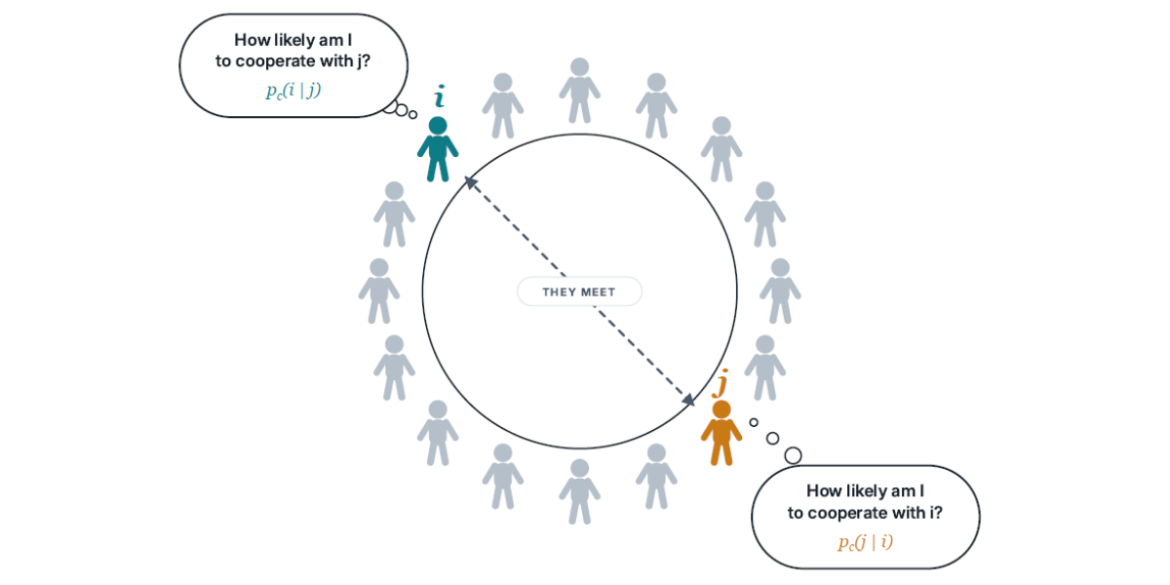
But a new study by Dr Alexander Feigel of the Racah Institute of Physics at the Hebrew University of Jerusalem and Prof Alexandre V. Morozov of Rutgers University demonstrates that evolution may be far more optimistic than previously believed. Their findings reveal that cooperation does not require close family ties, reputation, repeated favors, or rigid social structures. Instead, cooperation can flourish simply because individuals respond differently to different opponents.
Published in the Proceedings of the National Academy of Sciences (PNAS), the research proposes a new solution to one of biology’s oldest puzzles: how cooperation survives in a world shaped by natural selection.
“Conventional evolutionary theory predicts that defectors—those who always act selfishly—should eventually outcompete cooperators,” said Dr Alexander Feigel. “Our work shows that this isn’t necessarily true. Once individuals recognize that not every opponent is the same, cooperation becomes surprisingly robust and can emerge spontaneously.”
Using mathematical models, evolutionary simulations, and populations of artificial intelligence agents, the researchers found that cooperation consistently evolved when individuals adjusted their willingness to cooperate according to whom they encountered. Rather than treating everyone identically, simple opponent-specific responses created stable communities in which cooperative behavior repeatedly outperformed purely selfish strategies.
“Our results suggest that nature doesn’t need perfect altruists for cooperation to evolve,” added Prof Alexandre Morozov. “Individuals simply need to respond differently to different partners. That simple principle is enough to allow cooperation to survive—even under evolutionary pressures that were previously thought to favor selfish behavior.”
Perhaps the study’s most surprising finding is that cooperative societies are not fragile exceptions. Across thousands of simulations, populations repeatedly evolved toward highly cooperative states, while purely selfish populations often failed to dominate. Even when mutations introduced new defectors, cooperative communities remained remarkably resilient.
The implications extend far beyond evolutionary biology, which aims to explain cooperation among populations of cells, microbes, plants, and animals. Similar principles may inform the design of more collaborative artificial intelligence systems, autonomous robots, and distributed computing networks.
The researchers argue that the ability to distinguish between different partners—a capability found throughout nature, from single cells to humans—may have been a fundamental stepping stone in the evolution of complex life.
“If cooperation can emerge without elaborate rules or sophisticated cognition, it becomes much easier to understand how complex biological systems evolved in the first place,” said Feigel. “Perhaps evolution has always been more cooperative than we gave it credit for.”
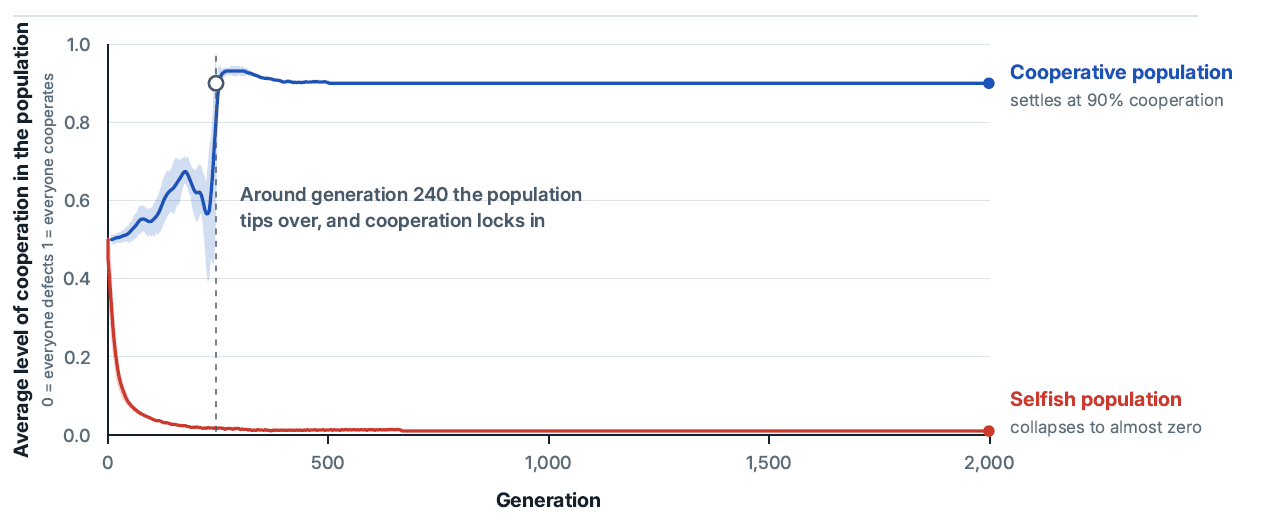
EVOLUTION OF COOPERATIVITY IN THE PRISONER’S DILEMMA
Two simulated populations followed over 2,000 generations. One tips into near total cooperation and stays there. The other collapses into selfishness. Each line is the average cooperativity of a population; the shaded band is the spread between its individuals. Cooperation does not creep upward gradually. It stays contested for a while, then flips and becomes stable, and it survives even when new selfish mutants keep appearing.
Credit: Morozov & Feigel


Alexandre Morozov | Credit Maria Morozov Alexander Feigel | Credit: Amiran Bechori
Publication
Morozov, A.V. & Feigel, A. Emergence of cooperation due to opponent-specific responses in Prisoner’s Dilemma. Proceedings of the National Academy of Sciences (PNAS) (2026). https://www.pnas.org/doi/abs/10.1073/pnas.2513282123
Media Contacts
Prof. Alexandre V. Morozov, Department of Physics & Astronomy, Rutgers University
Tel: +1 848-445-1387 Email: morozov@physics.rutgers.edu
Dr. Alexander Feigel, Racah Institute of Physics, Hebrew University of Jerusalem
Tel: +972 54-480-7148 Email: alexander.feigel@mail.huji.ac.il
Research Paper
Morozov, A. V., & Feigel, A. (2026). Emergence of cooperation due to opponent-specific responses in Prisoner’s Dilemma. Proceedings of the National Academy of Sciences (PNAS), 123(21), e2513282123.
DOI: https://doi.org/10.1073/pnas.2513282123
Authors:
Alexandre V. Morozov, Ph.D., Alexander Feigel, Ph.D.
Affiliations:
- Department of Physics and Astronomy, Rutgers, The State University of New Jersey, Piscataway, New Jersey, USA.
- The Racah Institute of Physics, The Hebrew University of Jerusalem, Edmond J. Safra Campus, Jerusalem, Israel.