We are proud to share with our British Friends the important work made possible thanks, in part, to your generosity. At the Hebrew University’s Clinical Legal Education Center, your support helps law students gain hands-on experience while providing vital legal aid to individuals and communities who might otherwise struggle to access justice.
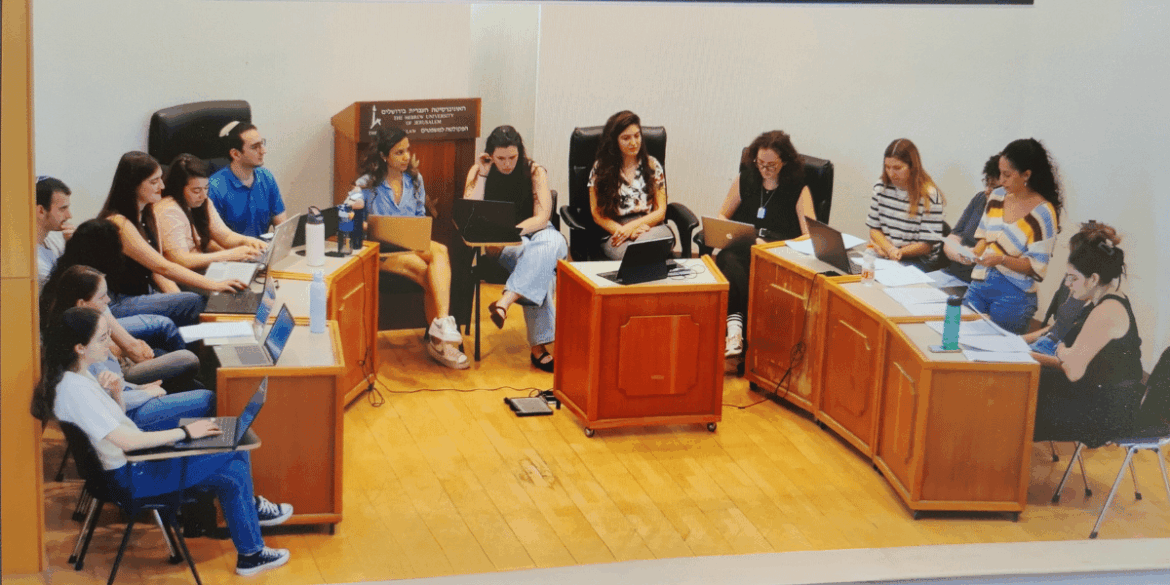
Title image: Moot Courtroom. Faculty of Law, Mount Scopus Campus
Legal training with purpose
The Clinical Legal Education Centre is an integral part of the Hebrew University’s Faculty of Law and one of Israel’s leading clinical centres. Its approach combines high-quality legal aid for disadvantaged individuals and groups with outstanding practical training for students.
Under faculty supervision, students take part in real legal work, attend forums and workshops, and develop the skills needed to represent clients effectively. They also learn from professionals in other fields, including social work, business administration and disability studies, gaining a broader understanding of the social, cultural and ethical dimensions of the legal profession.
This investment in students has lasting value. Many CLEC alumni carry a strong sense of social responsibility into their careers, helping to shape a more compassionate and engaged legal profession.
This fourth article in our series highlights the Clinic on Climate Change and Environmental Law, and the Clinic for the Realization of Rights in the Periphery
A major success came from the Climate Change and Environmental Law Clinic, which played a leading role in blocking sweeping amendments to the Economic Arrangements Law that would have sharply reduced the powers of the National Forest Commissioner and weakened protection for trees under the Forest Ordinance. Working alongside the environmental movement and in line with the position of the Attorney General, the Clinic submitted letters, position papers, and further advocacy efforts opposing the changes. Their arguments helped ensure that the proposed amendments — along with other harmful environmental provisions — were removed from the final bill.
The same Clinic also sought to join, as amicus curiae, a petition concerning the natural areas of the Sovev Hadassah Ein Kerem region. Together with the Movement for Freedom of Information and Save the Jerusalem Hills, it argued that the agreement at the heart of the petition conflicted with municipal and governmental planning and climate policy, and failed to respect the precautionary principle in nature conservation. Although the Court rejected the request, the Clinic stated that it will continue monitoring the case and supporting efforts to preserve the area.
On the social rights front, the Clinic for the Realization of Rights in the Periphery secured a significant outcome for a single mother raising three children on a disability allowance. After her application for public housing was wrongly rejected due to a Ministry of Housing income miscalculation, the Clinic appealed the decision and succeeded. She has now been granted eligibility for public housing and, while waiting for an apartment, is receiving increased rent assistance.
The Clinic also filed an administrative petition on behalf of a client seeking recognition as a continuing tenant in public housing. Having lived his entire life in the apartment with his family, he was denied recognition after a flawed process in which ‘Amidar’ forwarded his application to the Ministry of Housing in violation of procedure, and the Ministry then rejected it without proper reasoning. The Clinic argued that the decision should be annulled and that he should be allowed to submit a reasoned appeal, with proper consideration given to the evidence of his long-term residence. In parallel, it also requested a stay of eviction proceedings pending the outcome of the petition.
Taken together, these updates reflect the Clinics’ ongoing work at the intersection of law, public policy, and human impact — from defending trees and open landscapes to securing housing rights for vulnerable families.