
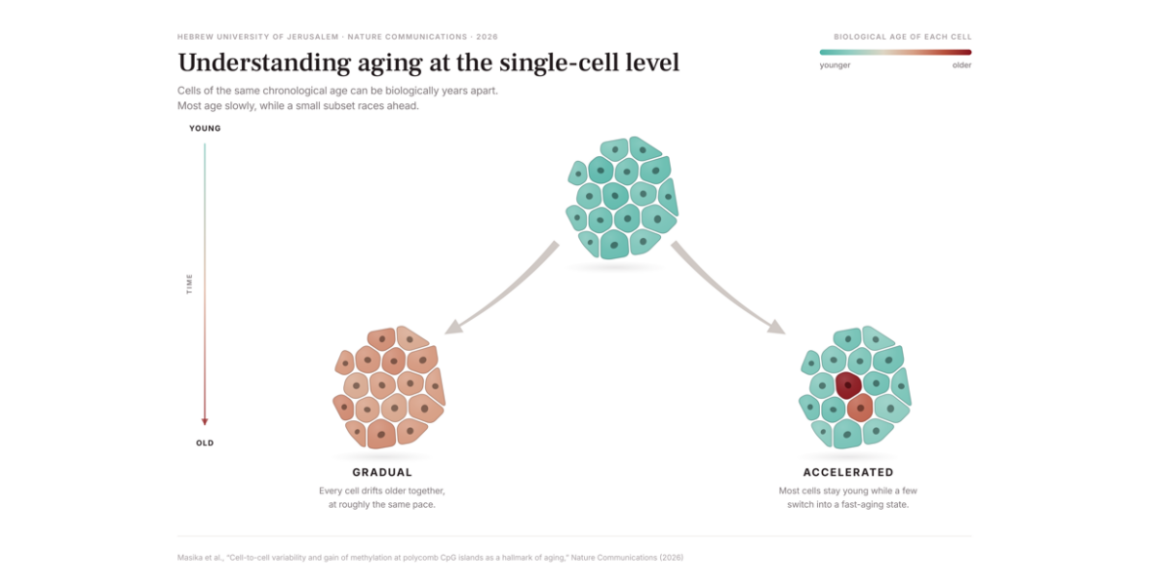
New research reveals that cells of the same chronological age can follow dramatically different biological aging paths, offering new insights into cancer, neurodegeneration, and the fundamental biology of aging. Rather than aging uniformly, tissues become a mosaic of biologically younger and older cells, with some individual cells aging much faster than others—a discovery that could reshape how scientists understand aging and the earliest origins of age-related disease.
We tend to think of aging as something that happens evenly throughout the body, a slow, synchronized process in which all cells age together. But according to a new study that’s not how aging works at all.
Instead, aging appears to be remarkably individual. Even within the same tissue, neighboring cells of identical chronological age can be biologically years apart. While most remain relatively “young,” a subset races ahead, accumulating the molecular changes associated with aging far more rapidly than their neighbors.
Published in Nature Communications, the study provides one of the clearest pictures yet of aging at the level of individual cells and offers new insights into why diseases such as cancer and neurodegeneration often begin in only a small number of cells.
The research was led by Dr Hagit Masika under the supervision of Prof Howard Cedar and Prof Tommy Kaplan of the Hebrew University’s Faculty of Medicine and Center for Computational Medicine and in collaboration with Prof Wolf Reik of Altos Labs and the Babraham Institute in Cambridge.
To uncover these hidden differences, the researchers analyzed DNA methylation—chemical marks on DNA that regulate gene activity and are among biology’s most reliable indicators of age. Rather than averaging millions of cells together, they examined cells one by one across multiple mouse and human tissues, revealing that aging unfolds very differently from cell to cell.
“The exciting part was realizing that two cells sitting side by side can have completely different biological ages,” said Dr Hagit Masika. “Once we could measure aging at the single-cell level, we discovered that tissues are much more heterogeneous than anyone appreciated. That gives us an entirely new framework for understanding how aging begins.”
The researchers found that tissues are made up of a mixture of slowly aging cells alongside a much smaller population of cells that age at an accelerated pace. They also discovered that rapidly dividing cells are more likely to enter this faster-aging state.
The findings also help explain a long-recognized hallmark of aging: the increasing variability between individual cells within the same tissue. Rather than aging in lockstep, cells gradually diverge from one another, creating a mosaic of biologically younger and older cells.
“Looking at individual cells instead of averaging entire tissues allowed us to detect patterns that were previously invisible,” said Prof Tommy Kaplan. “This gives us a much more precise picture of biological aging and opens new possibilities for identifying the cells that are most at risk of driving disease.”
The researchers note that this pattern is not universal. While the tissues examined in this study became increasingly heterogeneous with age, previous research has shown that some other tissues appear to age more uniformly, suggesting that different organs may follow distinct biological routes as they grow older.
The study went beyond identifying an aging marker. Cells with advanced epigenetic aging displayed altered activity in genes involved in immune function, protein production, neurodegeneration, and tumor development. In one striking experiment, the researchers compared black and white hairs taken from the same individual and found that white hairs consistently carried an older epigenetic signature—providing visible evidence that biological aging occurs independently in individual cells rather than uniformly across the body.
“This work changes the way we think about aging,” said Prof Howard Cedar. “Rather than every cell moving through time at the same pace, aging appears to be driven by individual cells that make the transition into an accelerated aging state. That helps explain why aging-related diseases often begin in only a small number of cells before expanding into a larger problem.”
The researchers believe the findings could help scientists identify the earliest cells responsible for age-related diseases and eventually guide strategies to slow—or even prevent—the biological processes that drive aging.
Research Paper
Cell-to-cell variability and gain of methylation at polycomb CpG islands as a hallmark of aging. Nature Communications (2026).
DOI: https://doi.org/10.1038/s41467-026-74118-5
Authors:
Hagit Masika, Shmuel Ruppo, Stephen J. Clark, Marc Jan Bonder, Ferdinand von Meyenn, Merav Hecht, Shari Orlanski, Efrat Katsman, Oriya Vardi-Yaakov, Abraham Zlotogorski, Tahel Fachler-Sharp, Sharona Elgavish, Yuval Dor, Wolf Reik, Tommy Kaplan, and Howard Cedar
Affiliations:
- Department of Developmental Biology and Cancer Research, Institute for Medical Research Israel-Canada, Faculty of Medicine, The Hebrew University of Jerusalem, Jerusalem, Israel
- Info-CORE, Bioinformatics Unit of the I-CORE at the Hebrew University of Jerusalem, Jerusalem, Israel
- Azrieli Omics Center, Center for Computational Medicine, Faculty of Medicine, The Hebrew University of Jerusalem, Jerusalem, Israel
- Altos Labs, Cambridge Institute of Science, Cambridge, UK
- Epigenetics Programme, The Babraham Institute, Cambridge, UK
- Division of Computational Genomics and Systems Genetics, German Cancer Research Center (DKFZ), Heidelberg, Germany
- Genome Biology Unit, European Molecular Biology Laboratory (EMBL), Heidelberg, Germany
- Department of Genetics, University of Groningen, University Medical Center Groningen, Groningen, the Netherlands
- Oncode Institute, Utrecht, the Netherlands
- Laboratory of Nutrition and Metabolic Epigenetics, Department of Health Sciences and Technology, ETH Zurich, Zurich, Switzerland
- Department of Medical and Molecular Genetics, King’s College London, London, UK
- The Lautenberg Center for Immunology and Cancer Research, Institute for Medical Research Israel-Canada, Faculty of Medicine, The Hebrew University of Jerusalem, Jerusalem, Israel
- Department of Bioinformatics, Jerusalem College of Technology, Jerusalem, Israel
- Department of Dermatology, Hadassah Medical Center, Faculty of Medicine, The Hebrew University of Jerusalem, Jerusalem, Israel
- Center for Computational Medicine, The Hebrew University of Jerusalem, Jerusalem, Israel
- School of Computer Science and Engineering, The Hebrew University of Jerusalem, Jerusalem, Israel
- Barts Cancer Institute, Queen Mary University of London, London, UK
- Centre for Epigenetics, Queen Mary University of London, London, UK