
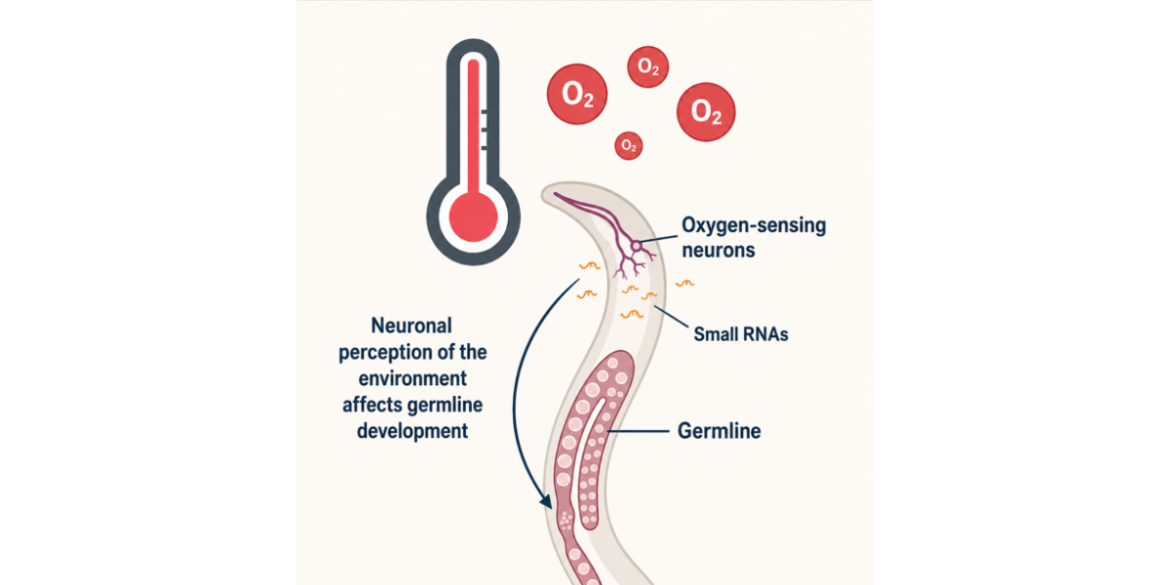
Researchers uncover an unexpected brain-to-germline communication pathway that safeguards reproductive cells during heat stress, demonstrating how environmental perception shapes fertility.
Title image: Germ Cell Development Under Thermal Stress Depends on Neuronal Small-RNA Signaling and Oxygen Sensing Credit: Credit: Yonatan Tzur / AI-assisted illustration
Why does extreme heat make it harder to produce healthy offspring? A groundbreaking new study suggests the answer lies far beyond the reproductive organs—inside the brain itself.
Scientists have discovered that the brain actively senses ambient conditions and transmits protective signals to safeguard fertility during heat stress. Published in Current Biology, the findings reveal a previously unknown communication system between the brain and reproductive cells, shedding light on how animals adjust reproduction when environmental conditions deteriorate.
As global temperatures continue to rise, understanding why heat so profoundly threatens fertility across the animal kingdom has become an urgent scientific priority. The research—led by Dr Yonatan Tzur of the Hebrew University of Jerusalem, alongside Dr Chee Kiang Ewe, Dr Hanna Achache, and Prof Oded Rechavi of Tel Aviv University—demonstrates that the brain plays a decisive role in determining whether reproductive cells survive environmental stress.
A Direct Line Between Neurons and Germline
For decades, the scientific consensus held that reproductive cells responded directly and independently to environmental stresses such as heat. However, this study proves that neurons actively prepare and defend the germline—the cells that generate sperm and eggs—by transmitting small RNA-based signaling molecules.
Using the microscopic worm Caenorhabditis elegans as a model organism, the team discovered that small RNA molecules produced in neurons are essential for preserving fertility at elevated temperatures. When researchers disrupted this neuronal signaling pathway, the animals became largely infertile in high heat due to impaired sperm development. Crucially, restoring the pathway strictly within the neurons was enough to substantially rescue the animals’ fertility.
The researchers also uncovered an unexpected secondary driver: oxygen-sensing neurons. By artificially altering how the nervous system perceived oxygen levels—without changing the actual surrounding environment—they improved reproductive success under heat stress. This suggests that animals integrate multiple sensory cues to evaluate whether conditions are favorable before committing energy to reproduction.
Preserving Genetic Integrity in a Changing Climate
Beyond protecting immediate fertility, this neuronal pathway helped preserve the genetic integrity of reproductive cells by significantly reducing heat-induced DNA damage. The discovery provides vital insight into how nervous systems coordinate whole-body defenses against environmental challenges, raising the tantalizing possibility that similar protective mechanisms exist in mammals and humans.
“We found that the nervous system isn’t simply reacting to the environment—it actively instructs reproductive cells on how to respond,” explains Dr Yonatan Tzur of the Hebrew University of Jerusalem. “The brain integrates environmental cues and relays them directly to the germline to protect fertility under stress. It fundamentally changes how we view the relationship between the nervous system and reproduction.”
Prof Oded Rechavi of Tel Aviv University adds: “As climate change increasingly threatens fertility across species, understanding how nature naturally protects reproductive cells is critical. Our work reveals a completely unexpected communication channel between the brain and germline that may represent a fundamental biological strategy for surviving environmental change.”
By deepening our understanding of how organisms balance reproduction against environmental hardship, the study opens exciting new avenues for fertility research, evolutionary biology, and climate resilience.
Media Contact:
Dr Yonatan Tzur, Alexander Silberman Institute of Life Sciences, Hebrew University
Tel: +972 54-733-4884 Email: Tzur@mail.huji.ac.il
Research Paper
Ewe, C. K., Achache, H., Schön, H., Kontorovich, L., Teichman, G., Weiss, S., Mogilevskaya, A., Valenski, M., Anava, S., Bardapurkar, R., Gingold, H., Posner, R., Antonova, O., de Bono, M., Tzur, Y. B., & Rechavi, O. (2026). Neuronal RNAi and oxygen-sensing circuit shape germline resilience to heat stress. Current Biology, 36. DOI: https://doi.org/10.1016/j.cub.2026.06.016
Authors:
Chee Kiang Ewe, Ph.D., Hanna Achache, Ph.D., Hanna Schön, Ph.D., Leonid Kontorovich, M.Sc., Guy Teichman, M.Sc., Shir Weiss, M.Sc., Anna Mogilevskaya, M.Sc., Myriam Valenski, M.Sc., Sarit Anava, Ph.D., Rutwik Bardapurkar, Ph.D., Hila Gingold, Ph.D., Rachel Posner, Ph.D., Olga Antonova, Ph.D., Mario de Bono, Ph.D., Yonatan B. Tzur, Ph.D., Oded Rechavi, Ph.D.
Affiliations:
- School of Neurobiology, Biochemistry and Biophysics, Wise Faculty of Life Sciences and Sagol School of Neuroscience, Tel Aviv University, Chaim Levanon Street 55, Tel Aviv-Yafo 6997801, Israel.
- The Alexander Silberman Institute of Life Sciences, The Hebrew University of Jerusalem, Givat Ram Campus, Jerusalem 9190401, Israel.
- Institute of Science and Technology Austria (ISTA), Am Campus 1, Klosterneuburg 3400, Austria.