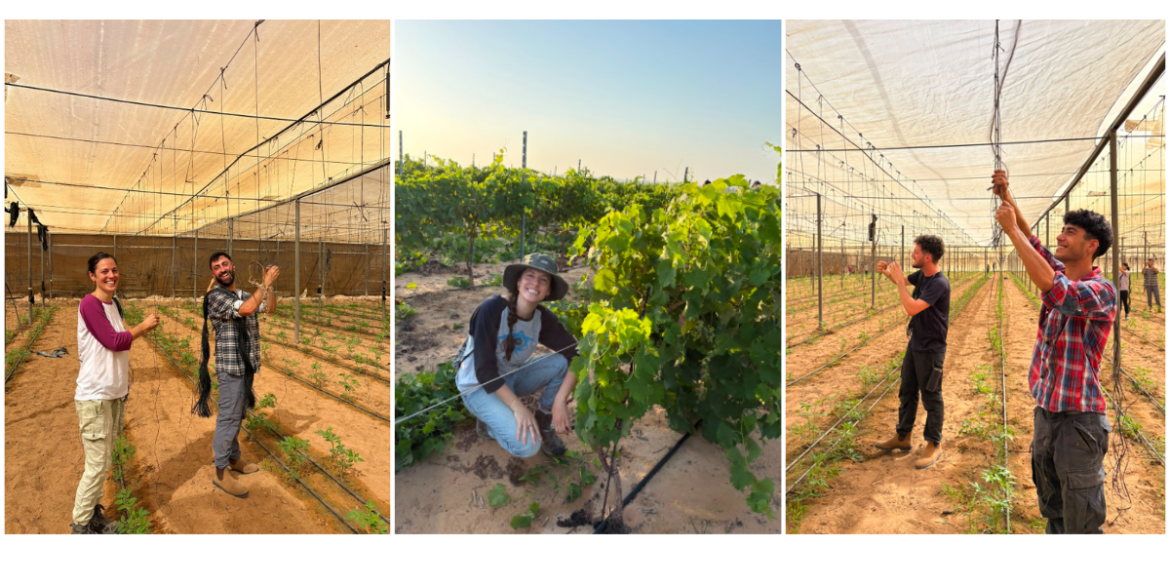
Students from the Hebrew University of Jerusalem began a unique summer course that combines academic study with agricultural volunteering at Kibbutz Sufa in the Gaza border region. The course integrates academic learning, agricultural volunteering and community activities and is being held in cooperation with Ein Prat – The Academy for Leadership.
The unique initiative includes 25 students who rose at dawn to volunteer in various agricultural activities, including trellising tomato plants, pruning and preparing land for pineapple planting in the communities of Kerem Shalom, Yated and Pri Gan. They also volunteered at early childhood education facilities in Kibbutz Sufa.
In the afternoons, the students participated in an academic course titled “Israel’s Education System: From Crisis to Recovery,” taught by Dr Adar Cohen of the Hebrew University’s School of Education.
The Hebrew University emphasizes that academia’s role is not limited to creating knowledge, but also includes transforming that knowledge into a force for action within society. The combination of academic learning, volunteering and hands-on work reflects the University’s commitment to Israeli society and the values it seeks to cultivate among its students.
Dr Adar Cohen, who leads the academic course, said: “The rehabilitation of the Gaza border region and the rehabilitation of Israel’s education system are, in my view, parallel and interconnected processes. By combining academic study, volunteering and shared community life, we aim to cultivate a generation of graduates who combine academic excellence with social responsibility and a commitment to Israeli society.”
Itamar Weinstein, a student in the Computational Biology and Computer Science program, said: “Beyond staying and studying in the kibbutz, volunteering alongside farmers in the Gaza border region was an incredible experience. Meeting them face to face, hearing what they went through on that terrible day and in the years since, and having the opportunity to ease their burden, even slightly, was a great privilege. Taking part in this work was also eye-opening and helped me understand more deeply the crisis we have been living through in recent years, both in education and more broadly.”
Lihi Peled, a student of Chemistry and Biology, said:“The academic content about the education system and shaping the next generation, combined with the stories of kibbutz members about the events of October 7, was extremely meaningful for me and added considerable value to the student learning experience. It was moving to hear these accounts firsthand, without a media filter, to look into people’s eyes and understand the significance of this moment. The combination of these two elements is no coincidence. The education we provide today will determine our future as a people.”
Ido Abramov, a student of Law and Social Work, said: “The course was highly meaningful and exceptional for me. Working on the ground, particularly in this part of the country, creates a sense of belonging and of contributing to something larger than ourselves. It brings together theory, through discussions about education and values, and practice, through encounters with local residents and action in response to the needs of the moment. This course is very different from ordinary university courses, where the emphasis is primarily on acquiring knowledge. Here, the focus is also on human encounters, dialogue, discussion and the creation of both an emotional and practical connection.”
Dr Cohen added: “Studying education in the heart of the lived reality of the Gaza border region, together with meeting the Sufa community and educators from the area, provided a depth, meaning and powerful experience that cannot be achieved in a conventional campus course. The connection to personal stories, the challenges of rehabilitation and the community’s capacity for renewal transformed the academic discussion about the future of the education system into an exceptional learning experience. It demonstrated how theoretical knowledge, practical experience and social engagement can come together and reinforce one another.”
The Hebrew University noted that the initiative will expand next summer to communities in northern Israel and to additional communities in the Gaza border region.
The initiative joins a wide range of activities promoted by the Hebrew University since the outbreak of the war, aimed at strengthening the connection between academia and Israeli society and contributing to the rehabilitation and resilience of communities throughout the country.