

New study identifies a new physiological principle in human physiology: “Social Physiology” – human bodies regulate glucose, temperature, and stress more efficiently in close social proximity
Title image: Illustration of Social Physiology by Shir Atzil/AI Assisted
We know that being near someone we love can make us feel good. A new study discovers why: it helps the body work better.
Published in Science Advances, research led by Prof Shir Atzil and PhD student Monia Masalha from Hebrew University and Dr Shai Fuchs from Sheba Medical Center, found that blood glucose after a meal is lower when eating in companionship, compared with when eating alone. After the same standardized carbohydrate meal, participants had smaller glucose spikes and quicker glucose recovery in the social condition.
The researchers call this principle Social Physiology: the human body regulate itself more efficiently in the presence of social partners.
“We used to think of the body as an isolated system that regulates itself,” said Prof Shir Atzil. “Our findings show that human physiology is inherently social. Being close to someone you love lowers the physical energy your body spends on regulating itself. This gives us a direct metabolic benefit to being together and reveals a core evolutionary reason why humans form bonds in the first place: our bodies run better together.”
Illustration of Social Physiology | Dr. Yitzchak Yadegari | HandMed
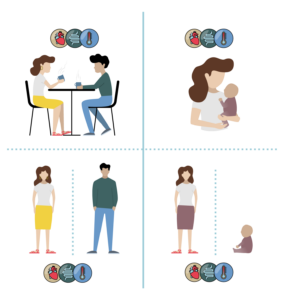
The effect extended beyond blood sugar. Social proximity also improved temperature regulation during cold exposure and reduced stress responses in adults and infants. The benefits appeared even without physical touch and were not explained by reduced stress. Across preregistered experiments, the evidence suggests that Social Physiology is a domain-general principle of human physiology.
At a time when blood sugar regulation is a growing global health concern, the findings suggest that metabolic health may be shaped not only by what is on the plate, but also by who is at the table.
“Blood sugar regulation is not just about what we eat, but who we eat with,” says Atzil. “Our relationships have an active biological role in our physical wellbeing.”
The findings offer a new way to understand human connection. Relationships may not only support our emotional lives; they may help regulate the body’s most basic systems.
The researchers emphasize that social closeness is not a substitute for medical care, nutrition, or exercise. But the study points to a powerful and overlooked factor in health: the people beside us.
This research was funded by the European Research Council (ERC) through the BioBond project (Grant Agreement No. 101116444), awarded to Shir Atzil.

Shir Atzil | Credit: Yaniv Vaknin

Monia Masalha | Credit: Monia Masalha
Media Contacts
Prof. Shir Atzil, Hebrew University of Jerusalem
Tel: +972 54-656-3888 Email: shir.atzil@mail.huji.ac.il
Research Paper
Masalha, M., Cohen, M., Aloni, M., Toledo, E., Stahl, E., Shachar, D., Eliav, O., Fuchs, S., & Atzil, S. (2026). Social Physiology: Human Homeostasis Is More Efficient in Social Proximity. Science Advances. https://doi.org/10.1126/sciadv.aeg4937 DOI: 10.1126/sciadv.aeg4937
Authors:
Monia Masalha, Matan Cohen, Maayan Aloni, Einav Toledo, Ella Stahl, Diane Shachar, Or Eliav, Shai Fuchs, Shir Atzil
Affiliations:
- Department of Psychology, The Hebrew University of Jerusalem, Jerusalem, Israel.
- Paediatric Endocrine and Diabetes Unit, Edmond and Lily Safra Children’s Hospital, Sheba Medical Center, Ramat Gan, Israel.