The Hebrew University of Jerusalem is proud to announce the signing of two new agreements with UCLA, marking an important step in strengthening academic and scientific collaboration between the institutions.
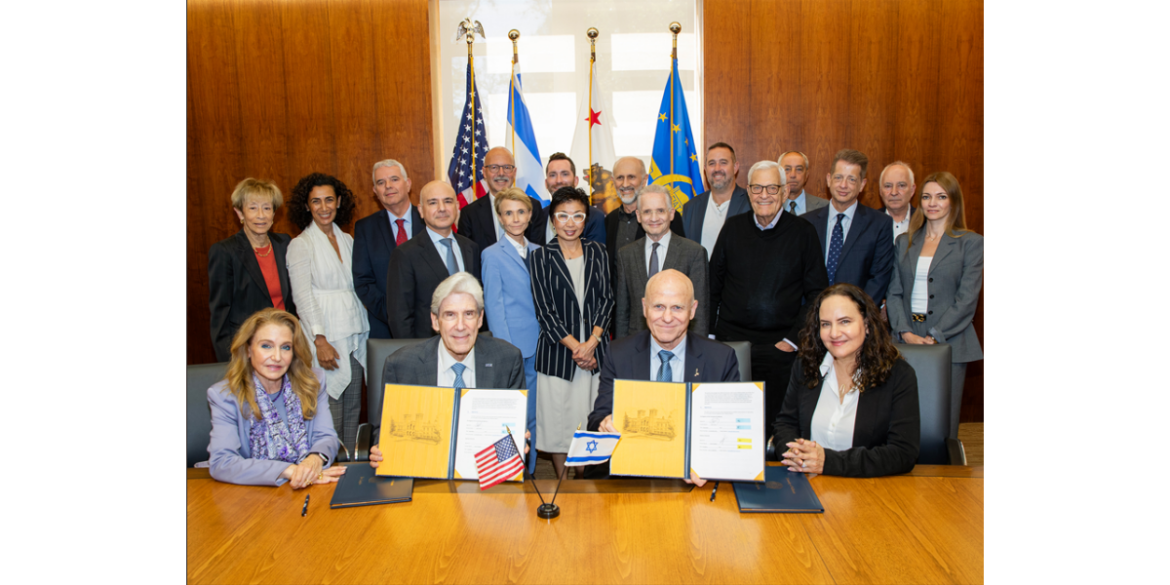
Title image: UCLA Chancellor Julio Frenk and The Hebrew University of Jerusalem President Tamir Sheafer sign the MOU between the Y&S Nazarian Center for Israel Studies and The Hebrew University on September 22, 2026, surrounded by representatives of the two institutions and friends and supporters. The two leaders also signed an MOU creating a framework to jointly pursue biomedical research. (Photo: Oliver Chien/ UCLA.)
The first, with the UCLA Younes & Soraya Nazarian Center for Israel Studies, a constituent part of the UCLA International Institute, has concluded a Memorandum of Understanding (MOU) with The Hebrew University of Jerusalem on pursuing complementary academic activities.
At the same signing event, UCLA, The Hebrew University of Jerusalem, and American Friends of the Hebrew University also created a framework for a future biomedical research collaboration.
The agreements were signed at UCLA on Tuesday, September 22, 2026, by UCLA Chancellor Julio Frenk and The Hebrew University President Prof. Tamir Sheafer, during a ceremony attended by leaders from UCLA, The Hebrew University, and American Friends of the Hebrew University.
“Research collaborations are essential to advancing science, expanding knowledge, and addressing the most urgent challenges facing society,” said Prof Tamir Sheafer, President of The Hebrew University of Jerusalem. “At a time when academic boycotts seek to limit exchange and cooperation, partnerships such as these affirm the value of open scholarship and the shared pursuit of discovery. We are also working together with UCLA to raise philanthropic support for joint research projects that will bring our scholars and scientists together around shared challenges. We are grateful to Chancellor Julio Frenk and UCLA, to the Nazarian family, and to American Friends of the Hebrew University in Los Angeles for their leadership, friendship, and commitment to strengthening academic cooperation.”
The MOU between the UCLA Younes & Soraya Nazarian Center for Israel Studies and The Hebrew University envisions the two parties working together on such activities as visits and informal exchanges of faculty and scholars for teaching and research; cooperation in post-graduate education and training; joint conferences and other meetings; academic information exchange; graduate and professional student exchanges; and joint research programs. Formal agreements on specific activities will be concluded as funding, space and other resources become available for their implementation.
“I am delighted that with this MOU, the Nazarian Center and The Hebrew University of Jerusalem signal their formal intent to work together on a broad variety of mutually beneficial academic activities,” said UCLA Professor Steven E. Zipperstein, director of the Nazarian Center. “The Hebrew University of Jerusalem is one of the premier institutions of higher learning in the world, featuring internationally renowned faculty, teaching, research and scholarship. We are thrilled to launch this collaboration with our colleagues in Jerusalem.”
The biomedical research agreement calls for the joint development of a UCLA–Hebrew University Biomedical Research Collaboration. The collaboration would establish research priorities, encourage interdisciplinary projects, and create new opportunities for learning, discovery, and scientific exchange. These efforts are intended to strengthen ties between the institutions. The David Geffen School of Medicine at UCLA will manage the research program for UCLA, but it will not be restricted to medical school faculty.
UCLA and The Hebrew University are internationally recognized leaders in biomedical research and medical education, and both universities share a commitment to scientific excellence, training future researchers, and translating scientific discoveries to advance patient care. The two universities are also working together to raise funds for joint research projects.
“By bringing together complementary expertise and resources, we can help accelerate discoveries that benefit patients far beyond our own institutions. Establishing this framework is an important first step,” said Dr Steven Dubinett, dean of the David Geffen School of Medicine and UCLA associate vice chancellor for research.
“These strategic agreements with UCLA are a testament to the high quality of Hebrew University’s science and scholarship,” said Prof Guy Harpaz, Vice President for International Affairs at The Hebrew University of Jerusalem. “They are also part of our global strategy to conclude scientific agreements with leading universities across North America, Asia, Europe, and Australia, strengthening international collaboration and expanding opportunities for our researchers and students.”
* * * * * *
The Younes & Soraya Nazarian Center for Israel Studies at UCLA promotes the study of the history, culture and society of Israel as a modern Jewish and democratic state. It sponsors courses for students of all backgrounds, conducts innovative research and brings leading Israeli scholars, policymakers and artists to UCLA for public programs and performances. Originally founded in 2005 as the UCLA Israel Studies Program, the Nazarian Center was established in 2010 as the first full-fledged Israel studies center on the West Coast with a generous endowment gift from the Y&S Nazarian Family Foundation.
The Hebrew University of Jerusalem was founded in 1918 and is today an Israeli public university with 14 schools, 7 faculties and 6 campuses. The university is ranked among the top 100 universities in the world, with a student body of 23,500 students from Israel and 65 other countries. Actively engaged in international cooperation in research and teaching, the university has signed 150 agreements for joint projects with other universities and 25 agreements for student exchanges with 14 countries. Hebrew University is a leader in bringing about global changes in agriculture, environmental quality and public health.