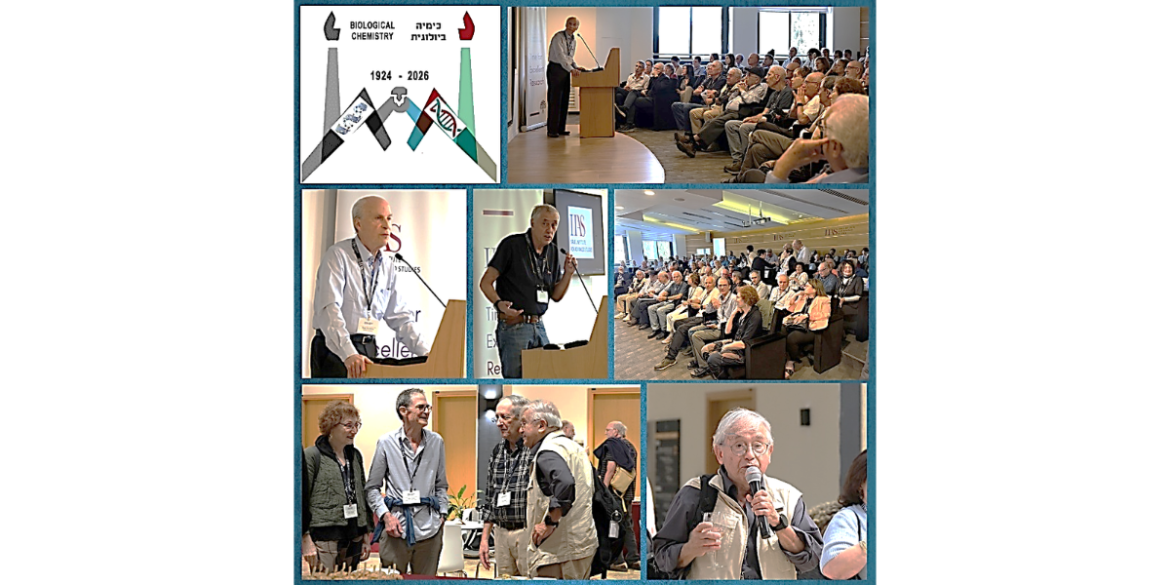
Nobel laureate Professor Roger Kornberg, Israel Prize winners Professors Eli Keshet and Yosef Yarden, and generations of researchers, alumni and students came together to celebrate a scientific tradition that began before the University officially opened.
Title image: From left to right: Prof Roger Kornberg delivering the keynote lecture. Prof David Engelberg-welcoming remarks, the audience in the main conference room. Profs Dani Cassel, Yossi Orly and Prof. Ioav Cabantchik making an announcement | Credit: Aviya Tikva
The Hebrew University of Jerusalem celebrated 102 years of biological chemistry on October 29, 2026, with a gathering dedicated to the department’s history, its scientific achievements and the community that continues to shape its future.
Held at the Israel Institute for Advanced Studies on the Edmond J. Safra Campus, Givat Ram, the event brought together faculty, alumni, students and colleagues for a day of scientific talks, personal recollections and reunions across generations.
Professor Emeritus Ioav Cabantchik, who organized the celebration together with Professor David Engelberg and Dr Michael Beigel, helped bring the department’s history to life. Drawing on archival materials and personal and collective memories, Cabantchik traced its beginnings in Professor Andor Fodor’s laboratory and paid tribute to the researchers, students and laboratory staff who shaped its development.
Nobel laureate Professor Roger Kornberg delivered the keynote lecture, with Israel Prize winners Professor Eli Keshet and Professor Yosef Yarden among the distinguished participants. The celebration also included Hebrew University President Professor Tamir Sheafer, Rector Professor Oron Shagrir and the Dean of the Faculty of Science.
“Very few departments can say that they are older than their university. This one can,” said Professor Oron Shagrir, Rector of the Hebrew University. “Before there were students filling lecture halls, there were already scientists asking questions and conducting experiments. That spirit of inquiry has carried through generations of researchers, students and staff, whose work has reached far beyond Jerusalem. As we celebrate this extraordinary history, we look forward to the discoveries and the people that will shape its next chapter.”
A scientific story older than the University
The department traces its beginnings to 1923, when Professor Andor Fodor began research on Mount Scopus, a year before Hebrew University’s official inauguration. From those early laboratories grew a tradition of research and teaching that helped lay the foundations of biochemistry in Israel.
At the gathering, Cabantchik and Professor Daphne Atlas revisited the department’s early years and development, while Professor Dan Cassel discussed the discovery of the GTPase cycle. Presentations by alumni and current faculty connected this history with research today, and younger researchers Eran Blacher and Einav Tayeb-Fligelman offered a glimpse of its future.
Behind the scientific milestones was also a story of resourcefulness and community. The department’s founding generations worked through shortages, war and repeated moves between sites across Jerusalem. Researchers, students, technicians and laboratory staff built both the facilities and the relationships that sustained its work.
One memorable chapter unfolded in Mamilla, where a former British Mandate police building became a lively home for laboratories and ideas. Professors Shlomo Hestrin and Michael Schramm helped shape this community, whose Thursday seminars attracted leading scientists from around the world. The friendships, shared learning and dedication of its staff became an enduring part of the department’s identity.
“From Andor Fodor’s first laboratory on Mount Scopus in 1923, generations of scientists helped lay the foundations of biochemical research in Israel,” said Professor Emeritus Ioav Cabantchik. “Through wars, scarcity, and repeated relocations, they sustained an unwavering commitment to discovery and teaching. Their legacy challenges us to keep questioning, pursue bold ideas, and inspire the next generation to advance science for the benefit of society.”
During the evening reception, two specially prepared films brought the history to life through interviews, personal memories and reflections on Hebrew University’s beginnings. They offered an opportunity to hear the voices behind the research and preserve their experiences for future generations.
One of the films, 102 Years of People and Memories, offers the wider University community a chance to share in those recollections.
The evening also featured a roundtable on receptors in biology and medicine, connecting the field’s past, present and future through the perspectives of departmental PhD graduates.
Across the day, the celebration recognized the generations of people who made biological chemistry at Hebrew University what it is today—and the curiosity, commitment and sense of community that continue to carry it forward.
Link to the event: https://iias.huji.ac.il/event/102-years-department-biological-chemistry
- 102 years – Memories, people places https://youtu.be/FspvZjshiOI
- 102:years- in pictures https://youtu.be/4HGruDiqjbc
- The early days of Biological Chemistry in Israel: https://www.youtube.com/watch?v=t-DBmYhz7nE