New research shows that eosinophils, immune cells usually linked to allergies, also play a protective role against Candida infections by using the CD48 receptor to recognize the fungus and release proteins that stop its growth. This discovery is important because it reshapes how we understand the immune system and opens the door to new therapies that could strengthen natural defenses against life-threatening fungal infections, a growing challenge in hospitals worldwide.
Link to pictures and video: https://drive.google.com/drive/folders/1SiQXsFqOm4OtQgVBpH_sSv70XK6ehgH5?usp=drive_link | Credit: Ilan Zaffran
A new study, conducted under the guidance of Prof Francesca Levi-Schaffer from the School of Pharmacy at the Hebrew University and led by PhD candidates Ilan Zaffran, Prince Ofori, and postdoctoral fellow Pratibha Gaur, uncovers how a surprising player in the immune system, eosinophils, best known for their role in allergies and asthma, also helps protect the body against Candida albicans, one of the most common and dangerous fungal infections in humans.
Eosinophils are white blood cells typically associated with allergy, asthma, and inflammation. But their role in fighting infections has been less clear. The new research shows that these cells are not just bystanders: they can recognize and attack Candida albicans, a fungus that can cause life-threatening infections in people with weakened immune systems.
The study identifies CD48, a key receptor on eosinophils, as central to this defense. CD48 binds to a fungal surface protein known as Als6, helping eosinophils recognize and respond to infection. This interaction triggers the release of powerful proteins, including major basic protein 1 (MBP-1), that limit fungal growth and survival.
Invasive Candida infections are notoriously difficult to treat and remain a serious threat in hospitals worldwide. By showing that eosinophils, cells once thought to act mainly in allergies, also play a protective role, this research opens the door to new therapeutic strategies that could strengthen the body’s natural defenses.
“This work changes the way we think about eosinophils,” said the researchers. “Far from being only culprits in allergic disease, they may actually be allies in fighting dangerous infections.”
By defining a new CD48–Als6 pathway, the study points to future possibilities for therapies that boost natural immunity. Harnessing the protective potential of eosinophils could one day improve treatment for patients vulnerable to invasive Candida disease.
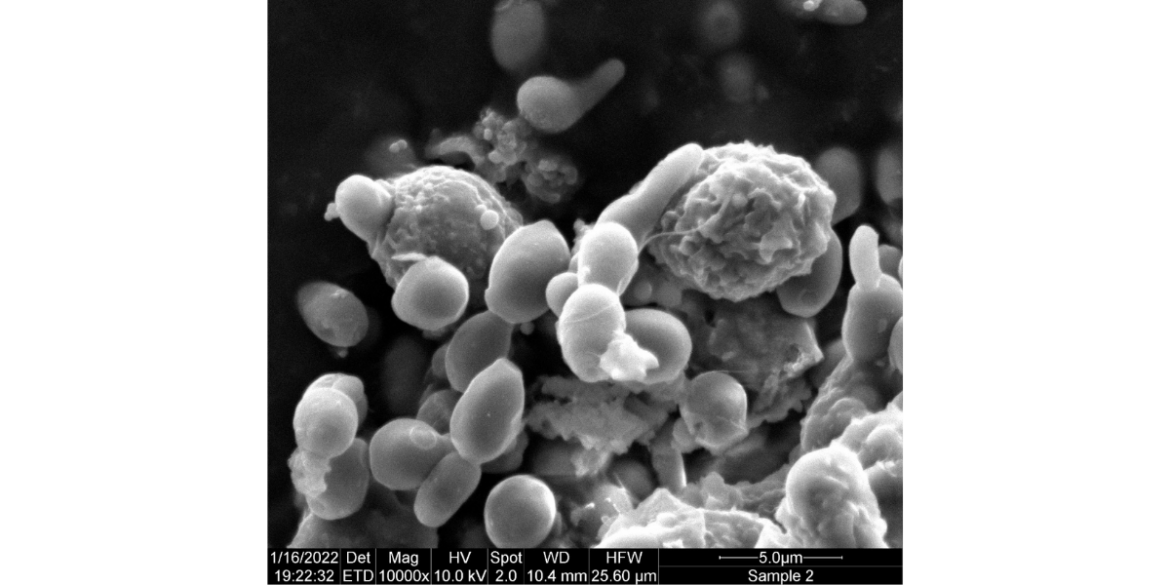
Scanning electron microscopy (SEM) image of human eosinophils incubated with C. albicans (MOI 1) for 30 min. White arrows show the engulfment of C. albicans by eosinophils and red arrows show eosinophil extracellular traps (X10000 magnification)
The research paper titled “Eosinophil 1 CD48 interactions with Candida albicans Als6 is protective in vitro and in mouse systemic candidiasis.” is now available in Nature Communications and can be accessed at https://www.nature.com/articles/s41467-025-64276-3
Researchers:
Ilan Zaffran, Pratibha Gaur, Prince Ofori, Yoav Charpak-Amikam, Hadas Pahima, David Shasha, Nir Osherov, Bernhard Hube, Ronen Ben-Ami, Julian R. Naglik, Ofer Mandelboim, Joana Vitte, Francesca Levi-Schaffer.
Institutions:
- Pharmacology and Experimental Therapeutics Unit, School of Pharmacy, Institute for Drug Research, Faculty of Medicine, Hebrew University of Jerusalem
- The Concern Foundation Laboratories at the Lautenberg Center for Immunology and Cancer Research, Institute for Medical Research Israel-Canada (IMRIC), Hebrew University Medical School, Jerusalem
- Infectious Diseases Unit, Tel Aviv Sourasky Medical Center; Sackler School of Medicine, Tel-Aviv University
- Department of Clinical Microbiology and Immunology, Sackler School of Medicine, Tel-Aviv University
- Department of Microbial Pathogenicity Mechanisms, Leibniz Institute for Natural Product Research and Infection Biology – Hans Knoell Institute, Jena, Germany
- Institute of Microbiology, Friedrich Schiller University, Jena, Germany
- Centre for Host-Microbiome Interactions, Faculty of Dentistry, Oral & Craniofacial Sciences, King’s College London
- Institut Hospitalo-Universitaire (IHU) Méditerranée Infection, Marseille, France
- Montpellier University, Institut Desbrest d’Épidémiologie et de Santé Publique, Institut National de la Sante et de la Recherche Medicale, UMR UA 11, Montpellier, France