For Marc’s family, support for the Hebrew University of Jerusalem has never been a passing interest or a single act of philanthropy. It has been woven through generations, shaped by conviction, memory and a deep belief in the power of education and community. From his great-grandparents’ Zionist commitment to his grandmother’s extraordinary dedication to the Friends of the Hebrew University, Marc’s story is one of inherited values becoming a personal lifelong bond.
That bond was visible long before Marc ever set foot on Mount Scopus. His great-grandparents were lifelong Zionists who devoted time and resources to the cause before the war, believing in the creation of the Hebrew University as the university of the Jewish people. Although history disrupted much of what they had built, the values they passed down endured. For Marc, that legacy would become central to his own relationship with the University.
Thea Zucker, a grandmother who made things happen
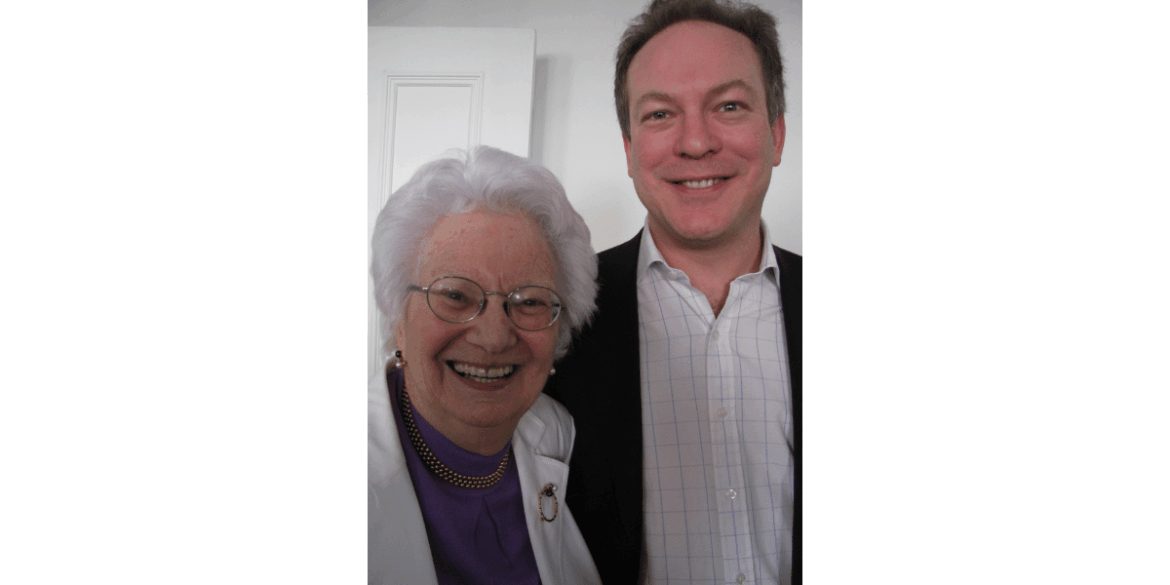
If one figure shaped this family’s connection most strongly, it was Marc’s grandmother Thea Zucker. She was not simply a supporter of the Hebrew University; she was an organiser, a connector and a determined advocate for the cause. Through her work with the Belgian Friends, she brought people together, arranging benefits and concerts, and invited visiting professors to speak and introduced audiences to the University’s remarkable academic life.
Marc remembers a childhood filled with stories of the University and the sense that it was something exceptional. His grandmother’s energy made the institution feel alive and present. That sense of purpose was recognised formally in 1995, when she was awarded an honorary fellowship. After his grandfather died, a plaque was installed in his name in Mt Scopus, and later, after his grandmother’s passing, her name was added too. The plaque remains a visible marker of a family history rooted in devotion.
In a fitting tribute to a woman who spent so much of her life turning belief into action, Marc created an annual lecture series in her memory, bringing speakers to share their work and celebrate the University’s spirit of intellectual curiosity.
Choosing the Hebrew University
Growing up in Antwerp, Marc did not expect to study in Israel. His family was not religious, but it was deeply committed to Jewish life, education and communal involvement. The Hebrew University stood out as something meaningful and aspirational, but even so, his decision to apply there came as something of a surprise to those around him.
“Going to the university without speaking a word of Hebrew and not knowing anybody there was a bit mad. But it was a life-building experience.”
He did not speak Hebrew when he applied, and his parents were realistic and not inclined to indulge pipe dreams. But Marc was determined. He needed strong results to enter the business studies and economics programme, and he also had to meet the language requirements. Against the odds, he succeeded. He completed his undergraduate degree at the Hebrew University and found himself not only studying at the institution he had heard about all his life, but becoming part of it.
That experience changed him. What had begun as a family legacy became personal. The University was no longer only the subject of family stories, but a place where he lived, learned and formed lasting connections.
Marc’s sister, Anne, followed suit, and, unbeknownst to him at the time, so did his wife, Silvia.
A microcosm of Israel
What Marc found at the Hebrew University was far broader than academic study. He discovered a diverse, energetic and intellectually rich environment that brought together people from across Israel and around the world. It was, in his view, a microcosm of Israeli society, and more than that, a microcosm of Jewish life in all its diversity.
That diversity made a deep impression on him. At the University, he encountered students from different backgrounds, religious traditions and nationalities, as well as people studying Hebrew who were not Jewish at all. The University’s international character, he says, strengthened the identity and sense of belonging of many who passed through it. For him, it helped shape a lasting connection not only to Israel, but to the Jewish people and to the idea of shared purpose.
After leaving for England, Marc remained closely connected to the University through the British Friends. He joined as a young alumnus, later became involved in governance, and at times served alongside his grandmother. Sitting together in plenary sessions, both of them part of the University’s wider family, was a moment he remembers with great affection.
A legacy that continues
For Marc, legacy is not measured only in plaques, honours or formal recognition. It is also found in the quieter but more enduring things: the stories told in families, the values passed from one generation to the next, and the institutions that continue to matter because of the people who support them.
He is realistic about the fact that universities, like people, do not remember every contribution in detail. But that does not diminish the value of giving, or of involvement. His grandmother’s work helped build events, raise funds and create opportunities that brought the Hebrew University to life for many others. And in his own way, Marc continues that work through memory, advocacy and the annual lecture he established in her honour.
He remains hopeful that the University will continue to thrive as a place of research, learning and connection. He sees its role not only in global academia, but in Israeli society itself: a place that reflects the country, contributes to it and helps shape its future.
For Marc and his family, the Hebrew University is more than an institution. It is part of their history, their identity and their understanding of what it means to give back. That is the essence of a legacy of devotion.