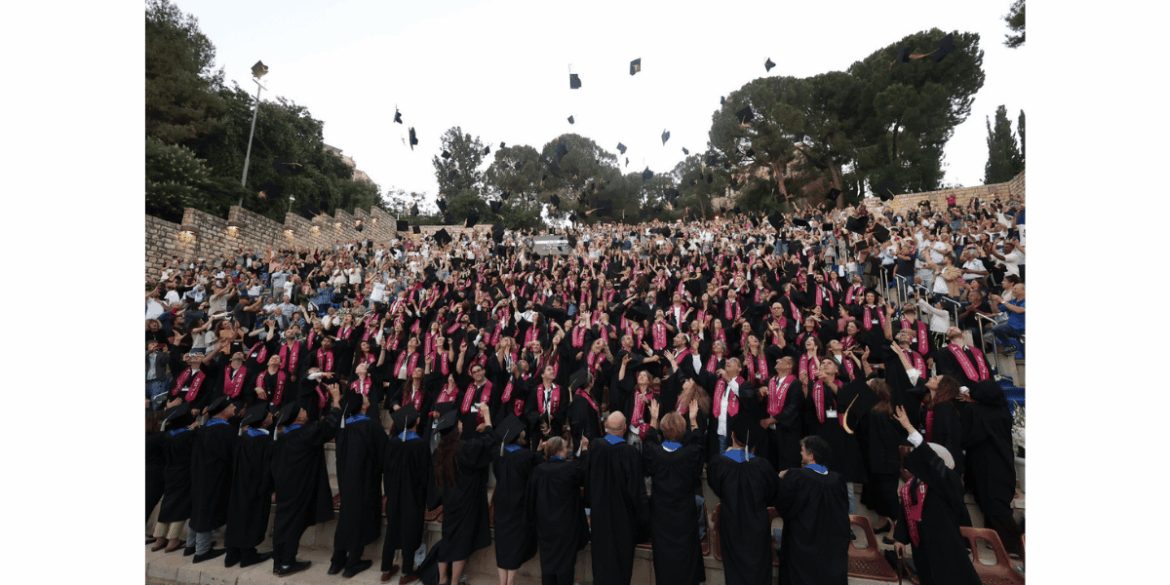
The Hebrew University of Jerusalem awarded 318 doctorates in the humanities, social sciences, and applied sciences at a festive ceremony yesterday. Among this year’s recipients, the oldest is 66 years old and the youngest is 27. More than half of the recipients are women (167 graduates).
Prof Oron Shagrir, Rector of the University, noted: “This year’s doctoral recipients join a community of researchers who are shaping the future of science, society, and the economy in Israel and around the world. Throughout their research journey, they have demonstrated determination, intellectual curiosity, and the ability to lead change and make an impact. Each and every one of them tells the story of academic and research excellence associated with the Hebrew University of Jerusalem.”
Among the notable graduates is Habtom Mehari Ghebrezghiabher, whose life journey has taken him from a struggle for survival to remarkable academic achievement. Habtom fled the brutal dictatorship in Eritrea, survived imprisonment and deportation in Kenya and Ethiopia, and in 2007 crossed the desert from Sudan to Israel on foot. Upon his arrival in Israel, he was sent to a detention center in Ketziot for two months. From there, he emerged into a complex reality in which he was forced to earn a living through hard labor in agriculture. He arrived in Israel holding a bachelor’s degree in statistics from the University of Asmara, along with an unwavering determination to fight for his future.
In 2016, he began his doctoral studies in sociology as part of a joint program focused on human rights in times of crisis. Habtom entered the program as a refugee from Eritrea and an asylum seeker in Israel. Alongside his studies, he was forced to contend with the constant uncertainty surrounding his and his family’s legal status, a reality that shifted repeatedly according to government policy and developments in Eritrea and Ethiopia. Following a long struggle, Habtom has now been granted legal status in Israel.
Habtom’s doctoral dissertation explored a compelling and important question: how diaspora communities from countries with authoritarian regimes continue to be influenced by the control mechanisms of the states they fled. His research demonstrated how fear, surveillance, and social and political pressures do not stop at national borders but continue to operate within immigrant and refugee communities. His work combined outstanding academic scholarship with insights rooted in personal experience. Habtom was able to identify processes that others might overlook, bringing to his research a unique blend of sensitivity, depth, and understanding born from the intersection of critical sociological inquiry and lived reality.
Habtom’s doctoral supervisor, Prof Yael Barda, a lawyer and faculty member in the Department of Sociology and Anthropology at the Hebrew University of Jerusalem, said: “Today, as we celebrate his achievements, I see not only a personal or academic success story. It is also a story about the power of knowledge, curiosity, and perseverance to overcome obstacles that sometimes seem impossible.”
Today, married and the father of four children, Habtom is completing an inspiring journey by receiving a doctorate in sociology from the Hebrew University. Alongside his extensive political and social activism on behalf of the Eritrean community, he has become a researcher who brings to Israeli academia a unique and profound perspective, as well as an insider’s view of issues related to geopolitics, migration, and society.
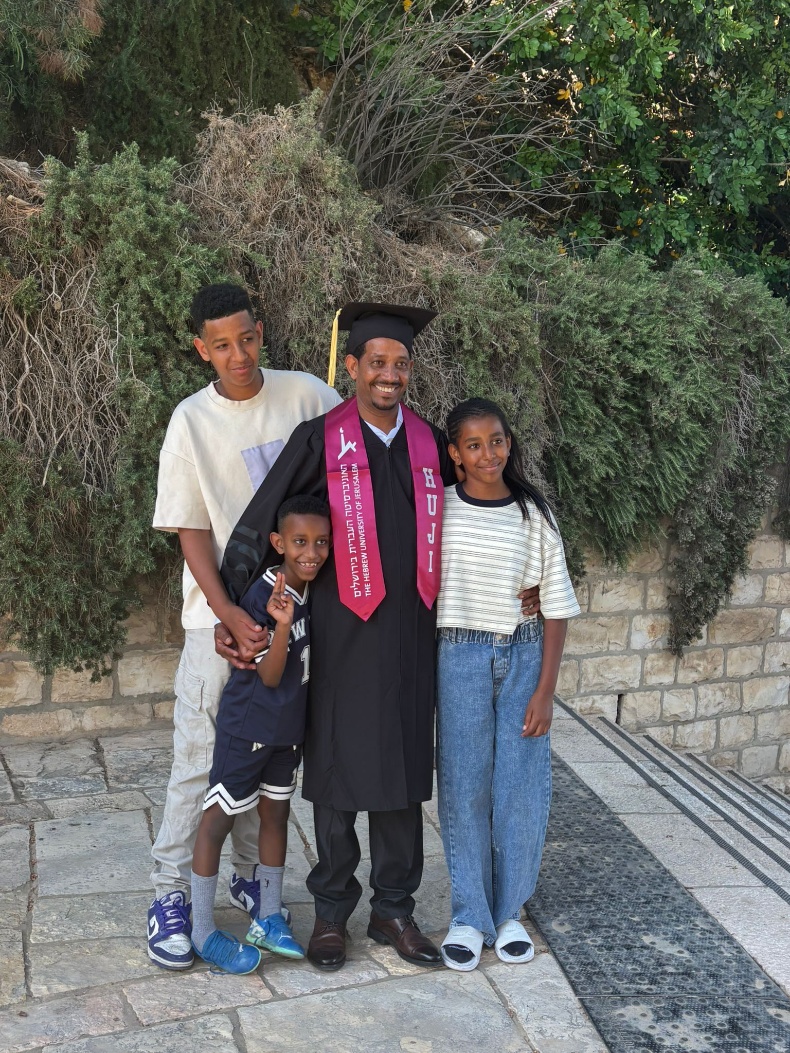
Upon receiving his degree, Habtom Mehari Ghebrezghiabher said: “I am excited to receive a doctorate from the Hebrew University today, and I would like to express my deep gratitude to the people of Israel for the protection I was granted and for the opportunity to build a better future for myself and my family. I am grateful to Dr. Yael Barda, who accompanied and guided me throughout my academic journey, to the Hebrew University, and to the Minerva Center for Human Rights.”
Photo Credits: David Salem