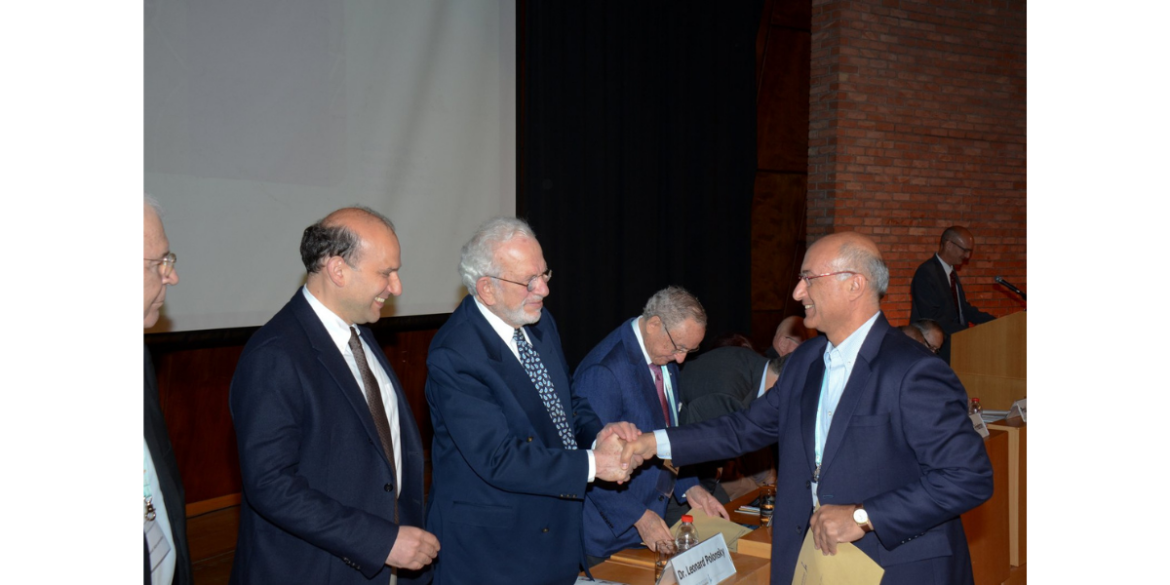
Marc Polonsky first came to understand the depth of his father’s bond with the Hebrew University in 1989, when he accompanied Dr Leonard S. Polonsky, CBE z”l to receive an honorary fellowship. What he found was not just a family connection to a university, but a legacy of thought, trust and purpose — one shaped by friendships, intellectual conviction and a belief in the Hebrew University’s wider role in Israeli society.
Dr Polonsky’s ties to the University were already well established by then. He had built close relationships with leading figures in the humanities, including Dean of the Faculty of Humanities Gabriel Motzkin, art curator Ahuva Passow Whitman and head of the English Department, Jon Whitman. His support extended into the everyday life of the campus — from books for the English Department library to lectures and initiatives that brought distinguished international scholars to Jerusalem. These were not abstract acts of patronage, but the kind that helped shape the intellectual texture of the University itself.
The humanities, in particular, were close to Dr Polonsky’s heart. Marc said his father believed the humanities mattered not only because of “the personal enrichment that they give,” but also because of the kinds of people they help to form: those who are “critically-minded, well-informed, engaged and empathetic,” able to broaden their understanding of the world and carry those lessons into public life. That conviction became the basis of the Polonsky Prizes in the Humanities, established to ensure that the humanities retained their standing alongside the sciences and technology.
The family’s support has also extended to East Asian Studies, especially China studies, where Dr Polonsky saw early on the importance of building stronger academic and cultural links. He was also deeply committed to supporting students of Ethiopian heritage, driven by a belief that Israel should not develop “a problem of an underclass based on colour,” and by the conviction that young people of Ethiopian background should have the same opportunities as other Israelis.
Marc describes his father’s approach as one rooted in trust. He would find people whom he thought had what it took to make things happen, and then give them the resources that they would need to do what they thought best. That approach — to identify talent, support it and step back — informed the family’s relationship with the Hebrew University. It also reflects a broader idea of philanthropy as an enabling force rather than a controlling one.
The Hebrew University, for Marc, remains central to the story of modern Israel. “We’re very aware of the importance of the Hebrew University to Israel,” he said, not only because of its role in building the nation since its foundation which predated the state, but because of its continuing influence and standing among the world’s leading universities. He also believes it should remain a place “for all citizens of Israel,” welcoming to minorities and alive to the diversity that makes collaboration most fruitful.
That vision shapes how he thinks about the future. Marc spoke about the pressures facing students, many of whom need to work while studying, and said he would like to see more support so that they can benefit from university life without that burden. He understands the benefits of cross-disciplinary learning and a strong humanities grounding before specialisation. At the same time, he is alert to the challenges posed by Artificial Intelligence and the changing shape of higher education.
For Marc, continuity matters — but so does adaptation. Following his father’s death in 2025, he said, the Polonsky Foundation trustees see their role as continuing the legacy and doing what Dr Polonsky set in motion, while responding to new needs as they arise.
In the end, the Polonsky relationship with the Hebrew University is a story of inheritance in the richest sense: not money alone, but values passed on, shaped and carried forward. It is a story about believing that universities matter not just for what they teach, but for the kind of society they help create. And through the stewardship of Marc and the other Polonsky Foundation trustees, Dr Leonard Polonsky’s vision continues to feel present — thoughtful, generous and alive.
HU BoG 2014, Kaye Awards, Polansky Prizes, Weiss Auditorium
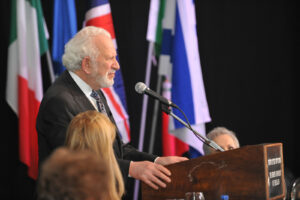
BoG 2013: Dr Leonard S. Polonsky, CBE z”l, on reception of his of Honorary Doctorate