
A new study published in the Proceedings of the National Academy of Sciences (PNAS) finds that individual human neurons are capable of significantly more complex computations than those of other mammals, offering a fresh view to what makes the human brain unique.
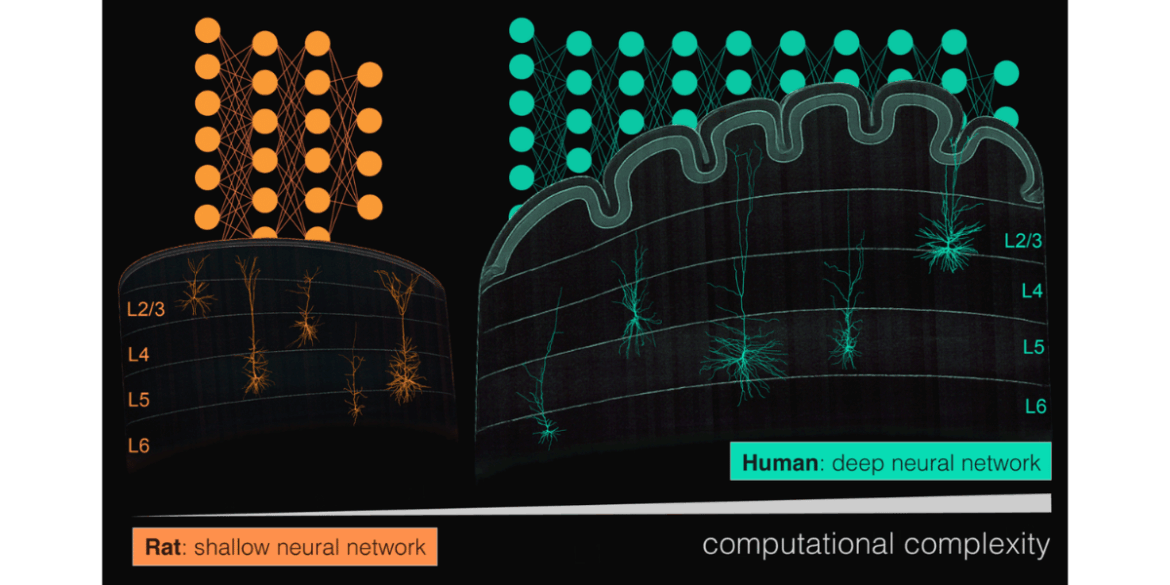
Title image: Deep Vs. Shallow Neural Network: Human cortical neurons are remarkably powerful computing devices. A single human cortical neuron has computational capabilities comparable to those of a deep neural network. Credit: Daniela Yoeli/ Hebrew University of Jerusalem
What makes the human brain capable of language, imagination, mathematics, and invention?
For many years, the prevailing view was that the secret of human intelligence lay mainly in scale: the sheer number of neurons in the human brain – close to 100 billion – and the vast network of connections among them. But a new study suggests that part of the answer may lie at a much smaller scale: in the extraordinary computational power of individual brain cells.
Researchers have found that neurons in the human cortex are significantly more complex information-processing units (“microchips”) than those of other mammals. The findings suggest that the building blocks of the human cortex may themselves be uniquely powerful, offering a possible explanation for how humans developed such exceptional cognitive abilities.
The study was led by Hebrew University researchers Profs Idan Segev and Mickey London, together with the PhD students Ido Aizenbud and Daniela Yoeli, at the Edmond and Lily Safra Center for Brain Sciences (ELSC), and in collaboration with Prof Chris de Kock from the Free University, Amsterdam.
“People often think of a neuron as a simple switch that either turns on or off,” said Segev. “What we show is that a single human neuron is itself an extraordinarily sophisticated computing device.”
To make the discovery, the researchers developed a new way to measure the computational complexity of individual neurons. Using advanced computer models and artificial intelligence, they assessed how difficult it would be for a state-of-the-art artificial neural network (ANN) to learn and reproduce the input/output behavior of a single brain cell.
The harder it is for the “twin” artificial network to imitate the input-to-output function of the neuron, the more computationally powerful that neuron is.
The results show that human cortical neurons have a remarkable computational advantage. Thanks to their richly branching dendritic trees and distinctive electrical properties, these cells can perform surprisingly complex computations on incoming information, such as visual input (e.g., distinguishing between images of cats versus dogs). This means that a single human cortical neuron is not just a simple “on-off” building block in the brain; it is already a sophisticated computing unit in its own right, with computational capabilities equivalent to those of a deep neural network.
The findings challenge the traditional view that intelligence emerges mainly from the number of neurons and the connections between them. Instead, they suggest that the sophistication of the neurons themselves may have played an important role in the evolution of human cognition.
The study also offers a new systematic and general framework fo linking the physical structure of brain cells to their computational abilities, bringing scientists one step closer to understanding how the human brain gives rise to thought, learning, and cognition.
The study may also inspire a new generation of brain-inspired AI, built from artificial units that are themselves computationally deep and powerful, more like biological neurons, and very different from the highly simplified units that underlie today’s state-of-the-art machine-learning systems.
Ido Aizenbud | Credit: Hebrew University

Daniela Yoeli | Credit: Hebrew University

Media Contacts: Prof. Idan Segev | Tel: +972 54-882-0610 | Email: idan@lobster.ls.huji.ac.il
Research Paper
Aizenbud, I., Yoeli, D., Beniaguev, D., de Kock, C. P. J., London, M., & Segev, I. (2026). Dendritic morphology and synaptic nonlinearities enhance functional complexity in human cortical neurons. Proceedings of the National Academy of Sciences (PNAS), 123(28), e2533168123.
DOI: https://doi.org/10.1073/pnas.2533168123
Authors:
Ido Aizenbud | Daniela Yoeli | David Beniaguev | Christiaan P. J. de Kock | Michael London | Idan Segev
Affiliations:
- The Edmond and Lily Safra Center for Brain Sciences, The Hebrew University of Jerusalem, Jerusalem 91904, Israel.
- Department of Integrative Neurophysiology, Center for Neurogenomics and Cognitive Research, Neuroscience Campus Amsterdam, Vrije Universiteit Amsterdam, Amsterdam 1081 HV, The Netherlands.
- Department of Neurobiology, The Hebrew University of Jerusalem, Jerusalem 91904, Israel.