
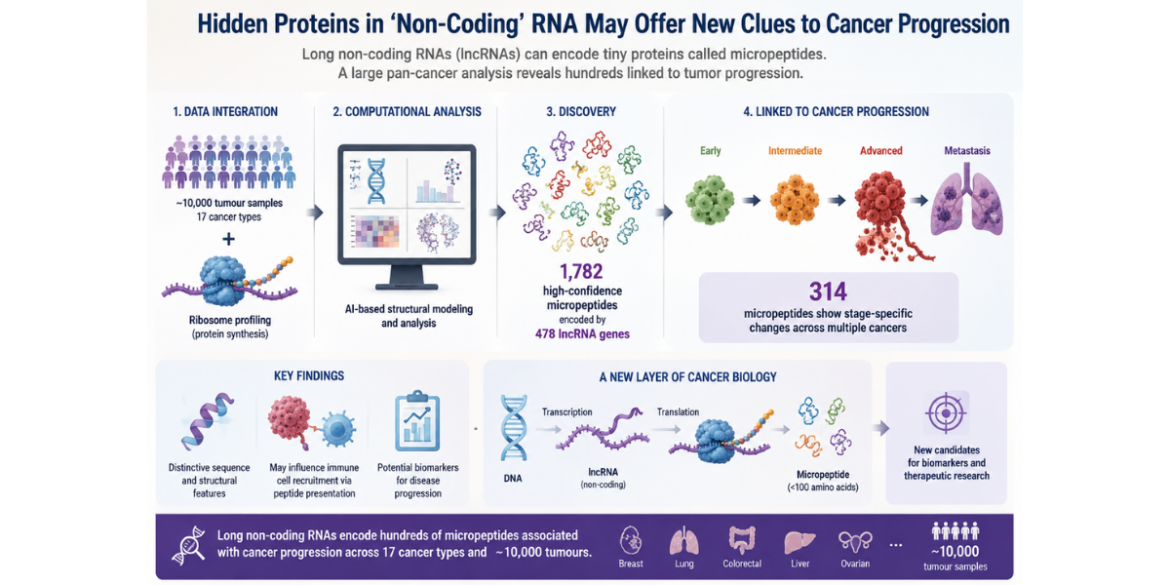
New study identifies hundreds of previously overlooked micropeptides linked to cancer progression. Hebrew University researchers have discovered that long non-coding RNAs (lncRNAs)—genetic material once thought not to produce proteins—can encode hundreds of tiny proteins collectively called micropeptides. By analyzing nearly 10,000 tumours across 17 cancer types, the team identified hundreds of micropeptides associated with different stages of cancer progression, revealing a previously underexplored layer of cancer biology that could improve understanding of how tumours develop and help identify future biomarkers.
Scientists have long believed that large stretches of our genetic material, known as long non-coding RNAs (lncRNAs), help regulate genes but do not produce proteins. A new study by Stav Zok and Prof. Michal Linial from the Hebrew University of Jerusalem suggests that this picture is incomplete.
Researchers have identified hundreds of tiny proteins, known as micropeptides, that appear to be encoded by this large class of RNAs. Many are associated with specific stages of cancer progression, pointing to a previously underexplored layer of cancer biology that could improve scientists’ understanding of how tumours develop and spread.
By combining cancer genomics data from nearly 10,000 tumour samples combined with data derived from ribosome profiling, thousands of micropetides were inspected by artificial intelligence-based structural modelling, the researchers identified 1,782 high-confidence micropeptides encoded by 478 long non-coding RNA genes.
Among them were 314 micropeptides associated with significant changes that occur as cancers progress through different stages.
“For years, these RNAs were largely overlooked as a source of proteins,” said Stav Zok. “By bringing together large cancer datasets with computational and AI-based tools, we were able to systematically uncover hundreds of overlooked candidate micropeptides that had been hiding in plain sight. We hope this tumour-centric catalogue will help other researchers investigate which of these molecules play meaningful roles in cancer progression.”
Rather than demonstrating the function of these molecules, the study, published in the British Journal of Cancer, provides one of the first systematic catalogues of micropeptides linked to cancer progression across multiple tumour types. The researchers also found that many have distinctive sequence and structural features, suggesting some may have biological functions that warrant further investigation.
“Our findings suggest that long non-coding RNAs may contribute to cancer in more ways than previously appreciated,” said Prof. Michal Linial. “These hidden micropeptides represent a largely unexplored class of molecules that could help us better understand cancer progression.”
The researchers emphasize that further laboratory studies are needed to determine the biological roles of these micropeptides. However, the work provides a valuable resource for future research and identifies promising candidates that may eventually prove useful as biomarkers for disease progression and specifically in recruitment of immune cells through peptide presentation on tumour cell surface.

Stav Zok (Credit- Stav Zok)

Prof. Michal Linial (Credit- Michal Linial)
Media Contacts
Prof. Michal Linial, Department of Biological Chemistry, The Life Sciences Institute, The Hebrew University of Jerusalem
Tel: +972548820035 Email: michall@mail.huji.ac.il
Research Paper
Zok, S., & Linial, M. Signatures of micropeptides encoded by lncRNAs in cancer progression and metastasis. British Journal of Cancer, 2026.
DOI: https://doi.org/10.1038/s41416-026-03556-1
Authors:
Stav Zok, Michal Linial
Affiliations:
- Rachel and Selim Benin School of Computer Science and Engineering, The Hebrew University of Jerusalem, Jerusalem, Israel
- Department of Biological Chemistry, The Life Sciences Institute, The Hebrew University of Jerusalem, Jerusalem, Israel