The Hebrew University of Jerusalem, in partnership with Edut 710, will unveil Edut AI, a new AI-powered management and search platform built around thousands of testimonies from October 7 survivors and witnesses. Launching as part of an international academic conference on memory, ethics, trauma, and artificial intelligence, Edut AI is designed to make the archive searchable and accessible for researchers, educators, students, journalists, creators, and the broader public. The project aims to preserve the voices and personal stories of those who experienced October 7 while enabling deeper study, responsible public engagement, and careful ethical reflection on how testimony, trauma, memory, and technology intersect.
On October 7, 2026, on the eve of the third anniversary of the October 7 attacks, the Hebrew University of Jerusalem, in partnership with Edut 710, will unveil Edut AI, a new AI-powered management and search platform built around testimonies from October 7 survivors and witnesses.
The launch will take place as part of an international academic conference titled “Edut 710, Archive of the Present: Memory, Ethics, and Trauma in the Age of Artificial Intelligence.” The event will bring together scholars from Israel and abroad to examine how artificial intelligence can help preserve, organize, search, study, and teach the testimonies of October 7 while confronting the ethical questions that arise when trauma, memory, and technology meet.
Unlike a traditional archive, Edut AI is designed to make a vast body of testimony searchable and accessible in new ways. The platform will allow users to explore thousands of personal accounts, identify themes and patterns, and engage with the human stories of those who were in the western Negev on October 7. It is intended for use by researchers, educators, students, creators, journalists, and the broader public in Israel and around the world.
“Collecting and preserving the testimonies of October 7 in a way that enables deep research is a critical historical undertaking,” said Prof Tamir Sheafer, President of the Hebrew University of Jerusalem. “At the Hebrew University, we see it as our responsibility to bring our research capabilities and most advanced computational tools to this effort, so that the memory of the catastrophe and the voices of the victims are not preserved only in a closed archive, but become a living infrastructure for study, remembrance, and public understanding in Israel and around the world. Above all, this work is about ensuring that the voices of survivors are heard, now and for generations to come.”
At the heart of the project is the question of how to make testimony accessible without flattening its complexity. Edut AI is being developed not as a replacement for the archive, but as a technological and ethical framework for engaging with survivor accounts, protecting dignity and privacy, and preserving the integrity of personal stories as they become part of public memory and historical research.
“An archive of the present raises new historical, legal and ethical questions: Who holds memory, how do we protect the privacy and dignity of witnesses who have experienced trauma, and what role does artificial intelligence play in shaping the historical narrative?” said Prof Renana Keydar of the Faculty of Humanities at Hebrew University. “The conference invites the academic community to confront these questions together and in real time, while the testimonies are still being collected and memory is still being formed.”
During the conference, participants will receive a first look at Edut AI and will be invited to experiment independently with its search and access tools. The day will also include discussions on testimony, memory, ethics, trauma, education, and the use of AI-assisted archival tools in historical research.
For Edut 710, the launch marks a major step in its mission to document and preserve as wide a range as possible of voices from October 7.
“We are pleased and proud of our collaboration with the Hebrew University and of the development of a unique search system that will allow the public in Israel and around the world to encounter thousands of stories and testimonies from those who were in the western Negev on October 7,” said Itay Ken-tor, CEO of Edut 710. “This is a meaningful step in realizing Edut 710’s vision: to ensure that the broadest possible range of voices, experiences, and human stories is heard, professionally preserved, and made accessible to future generations.”
The event will open with a lecture by Prof Michael Berenbaum, a leading historian and documentary filmmaker in the field of Holocaust studies who led the establishment of the United States Holocaust Memorial Museum in Washington, D.C. His remarks will address what can be learned from Holocaust archives and how those lessons may inform the preservation, search, and study of October 7 testimonies in the age of artificial intelligence.
Event Details
Location: Hebrew University campus, Jerusalem
Date: October 7, 2026
Time: 9:00 a.m.–6:30 p.m.
Conference language: Hebrew
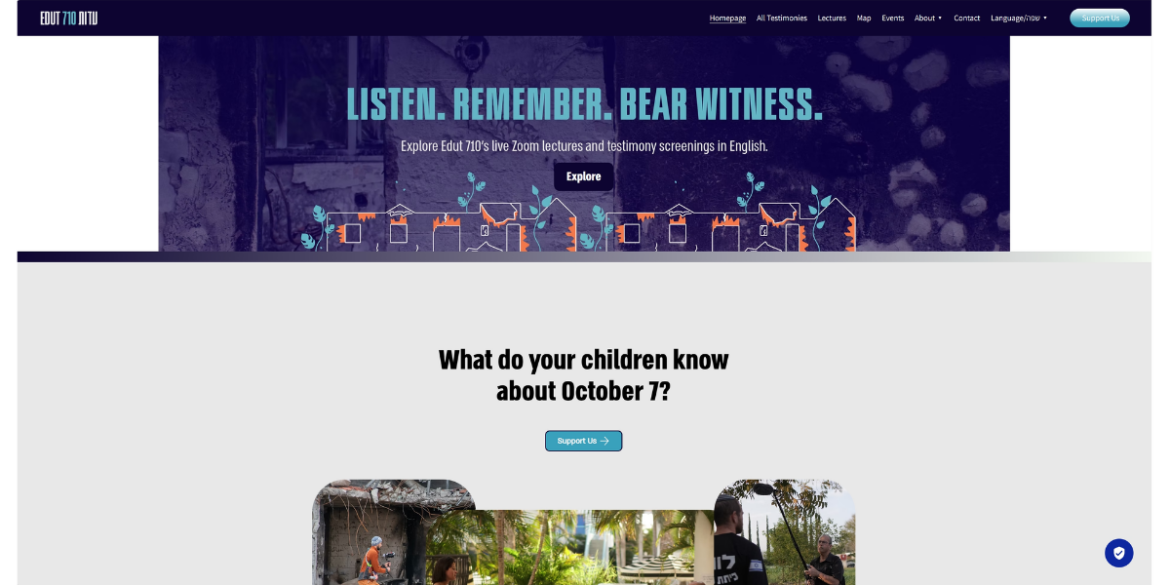
Registration: https://www.edut710en.org/
Media Contacts
Prof. Renana Keydar
Hebrew University
Tel: +972 58-658-2500
Email: renanakeidar@gmail.com
Itay Kantor
CEO of Edut 710
Tel: +972 52-283-4077
Email: kentormi@hotmail.com