

A new study reveals that habitat fragmentation can lead to sudden “tipping points” where a species’ genetic health unexpectedly collapses after appearing stable for long periods. By merging network theory with population genetics, the research identifies detectable “early warning signals” in genetic data that can alert conservationists to an approaching crisis before it becomes irreversible. These findings provide a practical toolkit for monitoring wildlife populations and protecting the genetic diversity essential for animals to survive a changing environment.
A study conducted by Ohad Peled and Prof Gili Greenbaum from Hebrew University and Prof Jaehee Kim from Cornell University offers a new tool for protecting endangered species by monitoring genetic changes in populations and identifying “early warning signals” before they reach a point of no return. Published in PNAS, the research introduces a network-based framework that helps conservationists predict when habitat fragmentation, the breaking up of natural landscapes, will lead to a sudden collapse in a species’ genetic health.
The authors noted that “populations can appear genetically healthy right up until they suddenly collapse, By the time traditional warning signs appear, it may already be too late. Our method gives conservationists a chance to act before that point.”
As human activity creates roads, cities, and farms, wildlife habitats are partitioned into smaller, isolated patches. This process, known as landscape fragmentation, restricts how animals move and breed, which can lead to inbreeding and a loss of the genetic diversity necessary for a species to survive environmental changes or diseases.
Until now, tracking this genetic decay has been difficult because traditional models often rely on simplified structures that do not reflect the complexity of natural migration patterns. “Existing theoretical frameworks do not adequately capture the heterogeneous migration patterns of natural populations,” the authors note.
By combining network theory with mathematical population genetics, the team simulated eight different real-world scenarios, such as the construction of railways or the gradual expansion of cities. They discovered that genetic health does not always decline at a steady rate; instead, it often hits a “tipping point”.
- The Deceptive Calm: In scenarios like random or spatially correlated disturbances, genetic changes are almost undetectable at first, even as the habitat is being lost
- The Sudden Transition: Once fragmentation reaches a certain threshold, genetic diversity can plummet rapidly and differentiation between groups can spike.
- The Early Warning: The researchers demonstrated that by tracking the statistical properties (like standard deviation) of genetic data across a whole network, scientists can see warning signs before the actual collapse occurs.
The study demonstrates that monitoring a single population is often insufficient to catch these signals. To effectively detect an approaching tipping point, conservationists should monitor multiple populations across a landscape to see how the “big picture” of their genetic health is shifting
To validate their model, the research team used real data and examined how different species are affected by fragmentation. Surprisingly, a population network of a cactus, a fisher, and a toad all behaved similarly under fragmentation and as expected by the model, providing promising opportunities to make practical change on the ground.
The findings are relevant for species ranging from large mammals such as wolves and elephants, which rely on vast migration corridors, to smaller, isolated populations like amphibians and desert reptiles whose habitats are increasingly fragmented.
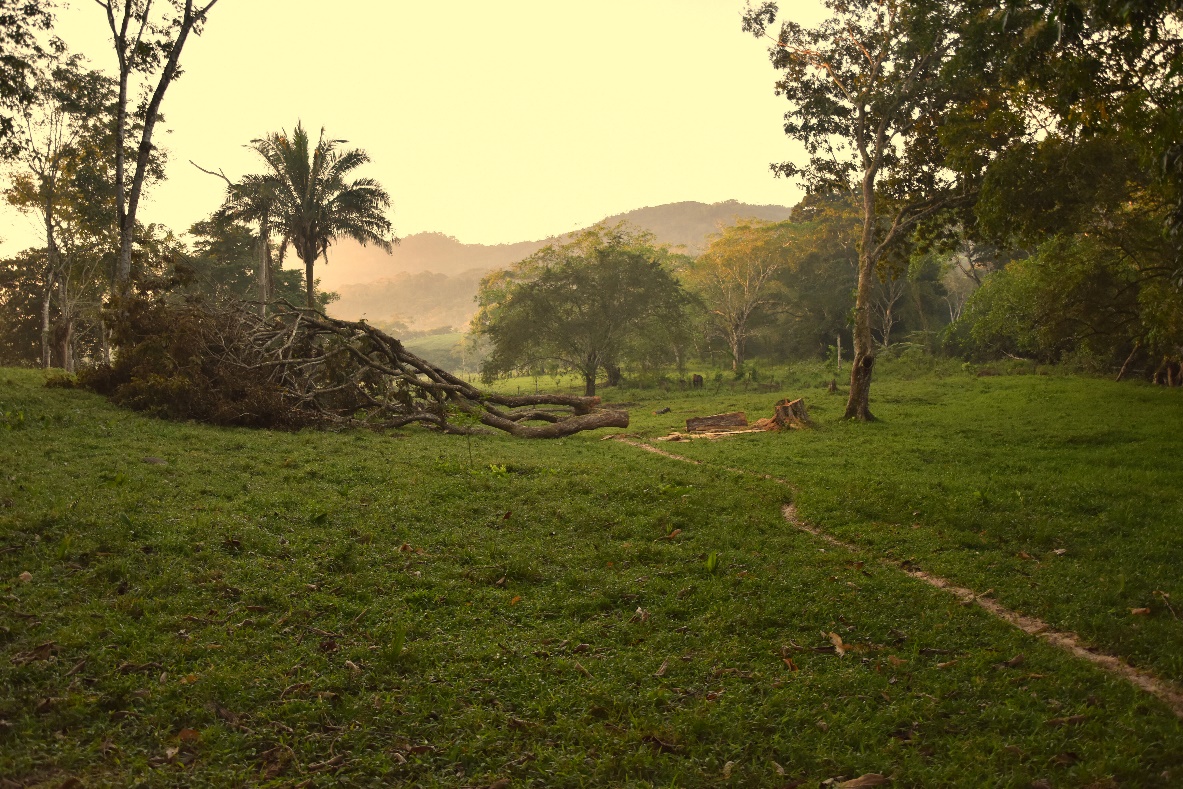
Deforestation in Mexico – A cut down tree in Palenque National Park, Mexico. (Credit: Ohad Peled)
The research paper titled “Network-based genetic monitoring of landscape fragmentation” is now available in PNAS and can be accessed at http://doi.org/10.1073/pnas.2515033123.
Researchers:
Ohad Peled, Jaehee Kim, and Gili Greenbaum
Institutions:
- Department of Ecology, Evolution and Behavior, The Hebrew University of Jerusalem
- Department of Computational Biology, Cornell University