

When Angela Camber (nee Birk) talks about the Hebrew University of Jerusalem, two words keep resurfacing: ‘pride’ and ‘possibility’. For more than three generations, her family’s name has been woven into the University’s story – from an early pre‑war scholarship fund to today’s Birk Prizes in Agriculture and Law and new initiatives in social work and legal outreach.
“I’ve always believed in enabling people,” she says. “If our prizes have played even a small part in helping someone move forward with what they’re doing, that’s what matters.”
A Legacy of Devotion article
A family story that begins before the war
The relationship began with Angela’s paternal grandfather, a committed Zionist who established a scholarship fund for the young Hebrew University sometime before the Second World War. At a time when the very idea of a university in Jerusalem was still bold and fragile, his gift signalled both confidence in the institution and hope for the future.
His son – Angela’s father – picked up the mantle. From the 1960s he chaired the British Friends of the Hebrew University for many years, and in the 1970s he was invited to serve as a governor of the University, a role he took “very seriously” and deeply enjoyed.
A key bridge between the family and the University was Prof Yehudit Birk, an exceptionally distinguished agricultural scientist and biochemist, who became the first woman to be elected Dean (in her case, of the Faculty of Agriculture), and acting rector of the Hebrew University. She received major national honours and recognitions, and was married to Angela’s father’s cousin, Meir Birk – a nuclear physicist at the Weizmann Institute. Yehudit and Meir became very close to the Birk family in England, and helped root Angela’s parents’ commitment to and passion for the ethos of the Hebrew University of Jerusalem.
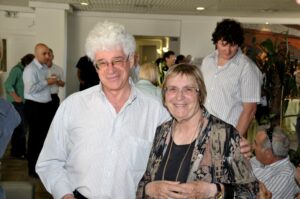
Prof Yehudit Birk with colleague Prof Eli Feinerman
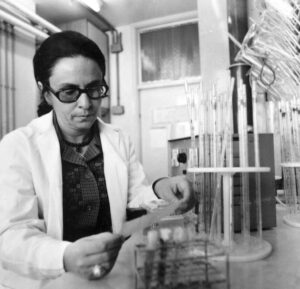
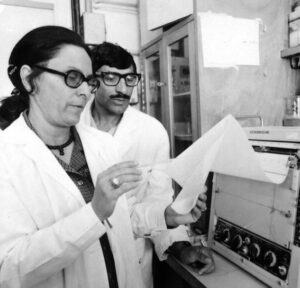
Prof Yehudit Birk
The Birk Prizes: excellence in agriculture and law
In 1993, Angela’s parents Ellis and Alma Birk formalised their connection by establishing what are now known as the Birk Prizes at the Hebrew University, recognising outstanding contributions in Agriculture and in Law. Their choices reflected both personal passions and professional identities.
Her father chose agriculture “because he absolutely loved anything to do with plants and flowers” – even if, Angela laughs, he wasn’t especially good at growing them. Her mother, a magistrate and member of the House of Lords married to a leading lawyer, selected law, driven by a deep interest in the rule of law and social policy.
Over more than three decades, these prizes have become a significant marker of excellence at the University, honouring researchers and practitioners whose work bridges academic rigour and societal impact. Many past recipients have gone on to become rectors, deans, senior public servants and leading scholars – proof, Angela feels, that the recognition can act as a springboard rather than just a medal on the wall.
“When I look down the list of names, I think: if this prize played even a tiny part in their journey, that’s more than good enough,” she reflects.

“You’ll do it”: being pushed into the spotlight
For years, Angela accompanied her parents to the annual prize‑givings. She remembers the early ceremonies as formal yet warm occasions, with the Rector, President and other university dignitaries present, followed by generous receptions where families, children and grandparents celebrated together.
Her own active role began almost by accident after her mother had died in 1996. At the first award ceremony after her mother’s death, as she and her father & brother prepared to go in, , her father suddenly turned to her: “You’ll do it,” he said. Angela assumed he meant fetching something. In fact, he meant the speech.
“I said, ‘What do you mean, I’ll do it? I’m here to support you!’ He just said, ‘You’re going to do it.’ And I did – and I’ve done it ever since.”
That moment of being “chucked into the deep end” has stayed with her as one of her clearest memories of the University. So, too, has the first time she heard prizewinners stand up and describe their work. “Utterly remarkable,” she says. “They are totally world‑class. Every time I hear them, I feel both humbled and excited.”
From receptions to recognition: adapting the prizes
In recent years, practical realities – first Covid, then the events after October 7 – have pushed the Birk Prize ceremonies online. Angela did what she could to keep a sense of occasion: insisting that recipients receive picnic baskets so they could celebrate together even while logging in from different places, and cherishing the joyful videos that followed.
But the shift also prompted a harder question: what is the best use of limited funds? With winners now often scattered across Israel and around the world, she decided to abandon in‑person receptions entirely.
“I’ve said very clearly: let’s keep it simple online, and put that money back into the prizes,” she explains. “I’d rather they receive more support for their work than another glass of wine in a room.”
Broadening the legacy: law clinics and social work
True to her instinct to “go her own way”, Angela has gradually extended her parents’ legacy into new, less traditional areas – always, she says, in ways she is certain they would have welcomed.
Drawing on her own background as a social worker, magistrate and long‑standing governor and honorary fellow of the London School of Economics, she began working with the Hebrew University’s law clinics. She wanted an award that would recognise *innovative* practice, not only classic academic achievements.
Since around 2020, two students or young professionals have been chosen each year for outstanding, creative work in the Law Faculty’s clinics – particularly in projects related to youth at risk, citizenship and social rights. Angela finds their projects “of tremendous interest”, even if security conditions have so far thwarted her attempts to join them on field visits, including one planned trip to the West Bank that was cancelled due to rocket fire.
More recently, by consolidating older funds – including her grandfather’s original scholarship and a trust commemorating her father’s youth work – she has helped launch new collaborations with the Social Work and Social Policy departments at Hebrew University. These projects, she says, feel like a natural extension of what her family began: “It’s all within the same genre, if you like – law, social justice, social policy. It’s about people.”
A university that “battles its way to the top”
Asked what most impresses her about the Hebrew University, Angela does not hesitate: its resilience.
From its earliest days, she notes, the University has operated in a “very, very difficult atmosphere” – geographically, politically and now reputationally, amid boycotts and campus tensions abroad. Yet it has “fought its way to the top”, growing significantly in size and global recognition.
She is especially proud of the University’s quiet success in attracting and supporting many Arab students – something she feels is under‑publicised but central to its identity. “They don’t gloat about it; they just do it because that’s what they want – a diverse population of students from first degree up,” she says. “I love seeing that mixture on campus.”
The events of recent months have made her worry that some of those students, and some staff, may not return, and she is candid about the wider political climate. But she insists that the University’s “can‑do” mentality remains intact – a mindset she sees reflected in how quickly faculties like social work and psychology adapted to support hostage returnees, and in the leadership’s determination to keep international research partnerships alive even when some doors close.
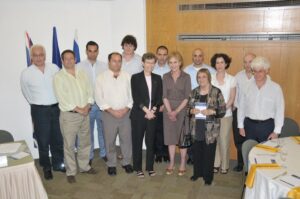
Ellis and Alma Birk Prizes in Agriculture & Law
Education as public service
For Angela, universities – whether LSE in London or Hebrew University in Jerusalem – have responsibilities well beyond research and teaching. She would like to see even more outreach into schools and less advantaged communities, instilling hope and ambition in young people who might otherwise dismiss elite institutions as “for clever people”.
“That’s civil society,” she says simply. “You can’t just live your life writing books and giving lectures. If you’re in these roles, you owe something to those who think they’ll never get in.”
It is no surprise that she is drawn to projects such as the Rights of Youth at Risk Clinic, which combines legal education, youth empowerment and policy change for vulnerable young people. They align perfectly with her lifelong focus on rehabilitation, adoption and second chances.
Pride, warmth and a springboard for others
When she thinks of the Hebrew University today, Angela lists three feelings: pride, warmth and commitment. “I don’t quite know why I feel so proud, because I haven’t done anything myself,” she says with characteristic self‑deprecation. “But I’m excited by what they do. It feels like a privilege to be even a small part of it.”
If there is a single thread running through her family’s long connection, it is the belief that recognition and opportunity – even in modest financial amounts – can change lives.
“I don’t like the phrase ‘making a difference’, but I do want to see people using their development in the big, wide world,” she concludes. “If our prizes and projects can help them take that next step – whether in agriculture, law, social work or beyond – then that’s the legacy I want.”