
Event Details
Wed 4th Feb 2026 @ 5:00pm - 6:15pm
Zoom
FREE
A Virtual panel discussion jointly sponsored by The Anglo-Israel Archaeological Society and British Friends of The Hebrew University.
The first-ever published research on Tinshemet Cave reveals that Neanderthals and Homo sapiens in the mid-Middle Paleolithic Levant not only coexisted but actively interacted, sharing technology, lifestyles, and burial customs. These interactions fostered cultural exchange, social complexity, and behavioural innovations, such as formal burial practices and the symbolic use of ochre for decoration. The findings suggest that human connections, rather than isolation, were key drivers of technological and cultural advancements, highlighting the Levant as a crucial crossroads in early human history.
The webinar will feature:
Professor Yossi Zaidner of the Hebrew University of Jerusalem:
Close Encounters of the Third Kind: Neanderthal and Homo Sapiens Interactions in the Mid-Middle Palaeolithic Era
Who Will You See There?
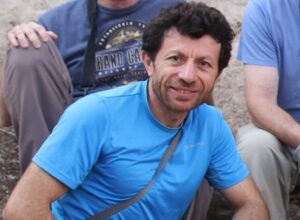
Prof Yossi Zaidner is a Paleolithic archaeologist, head of the Laboratory for the Study of Human Cultural Evolution, and a professor at the Institute of Archaeology, the Hebrew University of Jerusalem.
His research centers on human evolution, ecology, and behavior during the Lower, Middle, and early Upper Paleolithic.
The projects he is directing and collaborating with are rooted into the research of human culture, with an emphasize on the lithic technology, population interactions, origins of modern humans, the early hominins dispersals and the peopling of the Levant and Central Asia.
His major projects include:
- Middle Paleolithic in the Near East: Investigating early Homo sapiens, Neanderthals, and other Middle Pleistocene hominins through excavations at Tinshemet Cave and Nesher Ramla, with a focus on social structure, mobility, and symbolic behavior.
- Central Asian Paleolithic: Exploring human evolution, migration, and population interactions during the Middle and Upper Paleolithic in Tajikistan.
- Oldowan Hominins Outside of Africa: Studying the cultural behavior and environmental context of early Oldowan Toolmakers at Bizat Ruhama as they dispersed from Africa into Eurasia.
His 5 most important scientific contributions:
- Discovery of a Homo sapiens fossil dated to 180,000 years ago at Misliya Cave (published in Science)
- Discovery of Nesher Ramla Homo – a late Middle Pleistocene Homo (published in Science)
- Publication of the first archaeological evidence for interactions between late Middle Pleistocene Homo and Homo sapiens (published in Science)
- Study of interactions between archaic and modern human populations in the Middle Paleolithic, based on excavations at Tinshemet Cave (published in Nature Human Behavior)
- Identification and study of the first Oldowan site in the Levant at Bizat Ruhama, Israel (published as a book)
When Humans Met Neanderthals: The Discovery from Tinshemet Cave, Israel
FREE