
Indoor air quality is becoming harder to maintain in modern buildings without significant energy use. Vertical green walls offer a natural alternative, but their uneven performance and demanding maintenance have limited wider adoption. Now, researchers at the Hebrew University of Jerusalem have developed VertINGreen, a new platform that uses artificial intelligence, remote sensing and plant data to predict how green walls will perform before they are installed and to monitor their health in real time.
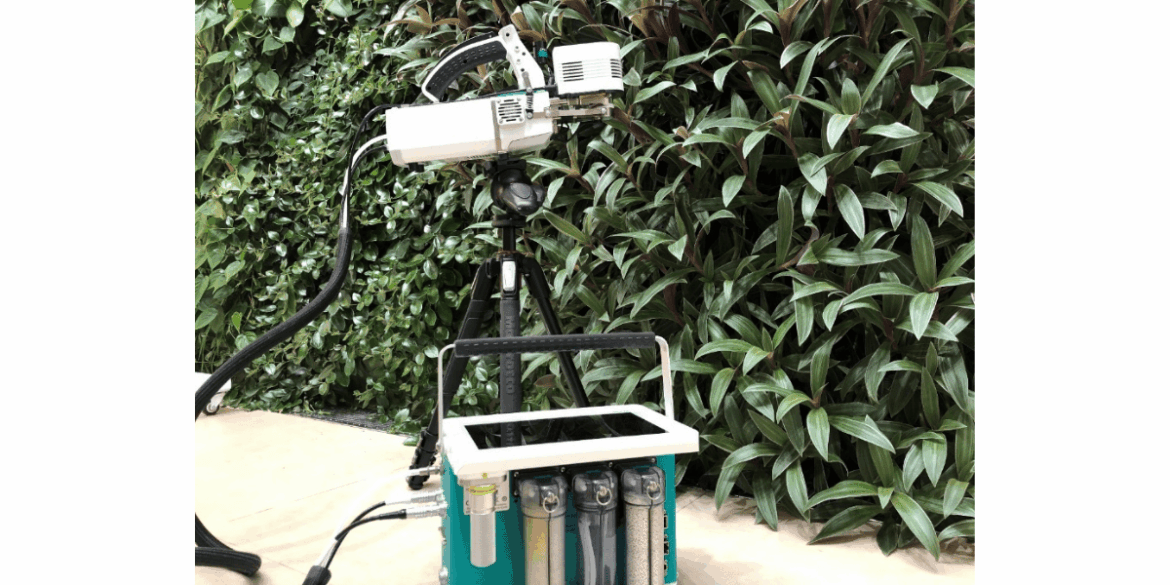
Title image: Gas-Exchange System (LI-COR LI-6800) Used to Measure Photosynthesis and Leaf Transpiration | Credit: David Helman Lab
In a new study published in Indoor Air, Yehuda Yungstein and Dr. David Helman present VertINGreen as a practical tool that turns vertical green walls from decorative features into smart, responsive systems. The platform is designed to help architects, engineers and building managers plan, assess and maintain indoor living walls with far greater confidence.
For years, green walls have fascinated designers and sustainability experts alike. They can improve the appearance of a space and, in theory, help clean the air and reduce energy use. But their real-world performance has often been difficult to predict. Some walls flourish, while others struggle to survive, requiring ongoing maintenance and offering little measurable benefit.
“Green walls have enormous potential, but until now, we lacked the tools to truly understand and manage how they function indoors,” the researchers explain.
VertINGreen addresses that gap by combining remote sensing technology with machine learning. The system was developed using nearly 2,000 measurements of how common indoor plants absorb carbon dioxide and release water under different conditions. These data were then used to build predictive models that can estimate how a green wall will perform before it is installed.
In practice, this means the platform can help users understand how much carbon dioxide a wall may absorb, how it will respond to indoor climate conditions and how it might reduce energy use by lowering the need for mechanical ventilation. For designers, that replaces guesswork with evidence.
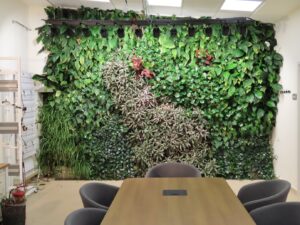
Vertical Green Wall in the Lab Used for This Study | Credit: David Helman Lab
The platform also continues to provide value after installation. Using hyperspectral imaging, VertINGreen can detect subtle changes in plant health that are invisible to the human eye. Paired with machine learning, this allows the system to identify early signs of stress, track plant activity across an entire wall and flag potential problems well before they become visible.
Importantly, the system can do this using only a small number of spectral bands, making it possible to use relatively affordable imaging equipment. That makes VertINGreen not only innovative, but practical and scalable.
More broadly, the platform points to a new way of thinking about buildings. Rather than relying entirely on energy-intensive mechanical systems, indoor spaces could increasingly incorporate living components that work alongside technology to improve environmental performance.
By combining accurate planning with real-time monitoring, VertINGreen offers a complete framework for cleaner indoor air, lower energy consumption and more resilient green infrastructure.
For Yungstein and Helman, the aim is to move this field from theory into practice. As they put it, VertINGreen helps bridge the gap between scientific understanding and real-world implementation, giving building professionals the tools they need to trust and make the most of nature indoors.
As cities continue to grow denser and buildings become more complex, innovations like VertINGreen offer a glimpse of a future in which walls do more than divide space — they help sustain it.
The research paper titled “VertINGreen: A Practical Application for Planning and Monitoring Indoor Vertical Green Living Walls Based on Remote Sensing and Machine Learning Models” is now available in Indoor Air and can be accessed at https://onlinelibrary.wiley.com/doi/10.1155/ina/5782002 .
Researchers:
Yehuda Yungstein, David Helman
Institutions:
- Department of Soil & Water Sciences, Institute of Environmental Sciences, The Robert H. Smith Faculty of Agriculture, Food and Environment, The Hebrew University of Jerusalem
- The Advanced School for Environmental Studies, The Hebrew University of Jerusalem