We are proud to share with our British Friends the important work made possible thanks, in part, to your generosity. At the Hebrew University’s Clinical Legal Education Center, your support helps law students gain hands-on experience while providing vital legal aid to individuals and communities who might otherwise struggle to access justice.
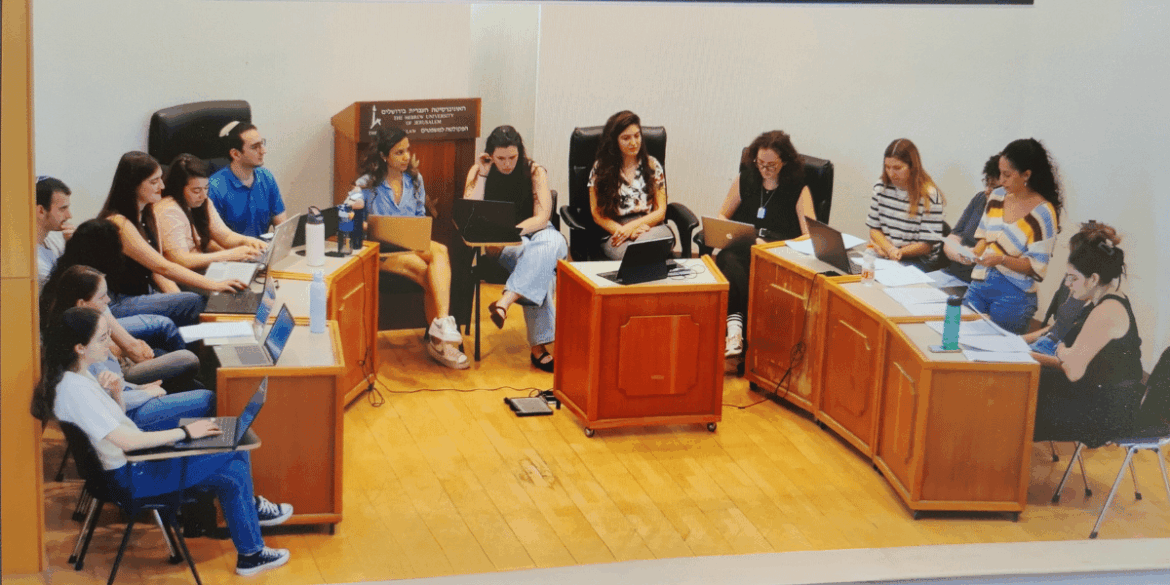
Title image: Moot Courtroom. Faculty of Law, Mount Scopus Campus
Legal training with purpose
The Clinical Legal Education Center is an integral part of the Hebrew University’s Faculty of Law and one of Israel’s leading clinical centres. Its approach combines high-quality legal aid for disadvantaged individuals and groups with outstanding practical training for students.
Under faculty supervision, students take part in real legal work, attend forums and workshops, and develop the skills needed to represent clients effectively. They also learn from professionals in other fields, including social work, business administration and disability studies, gaining a broader understanding of the social, cultural and ethical dimensions of the legal profession.
This investment in students has lasting value. Many CLEC alumni carry a strong sense of social responsibility into their careers, helping to shape a more compassionate and engaged legal profession.
This first article in our series highlights the Clinic on Human Rights in Cyberspace, which is addressing some of today’s most urgent digital challenges. In a world where online harm can spread instantly and remain visible indefinitely, the clinic is helping people respond to harassment, abuse, impersonation and exploitation with skill, persistence and care.
Responding to online harm
The Clinic on Human Rights in Cyberspace focuses on a rapidly evolving area of law: protecting rights in digital spaces. Online abuse can take many forms, from sexual harassment and impersonation to the circulation of intimate images and the misuse of social media platforms.
Because this harm is often difficult to trace and difficult to erase, the clinic combines legal advocacy with digital investigation, platform engagement and ongoing client support. Its work helps victims move from isolation toward accountability and justice.

Case study one: uncovering an impersonator
In one recent case, the Clinic filed an appeal on behalf of a young woman who had been sexually harassed online. An unidentified perpetrator had impersonated her on several websites, posted her photograph and phone number, and published degrading sexual propositions in her name.
The police initially closed the complaint on the grounds that the offender was unknown. The Clinic then contacted the relevant website, which provided identifying details linked to the fake accounts. An open-source intelligence investigation by the NGO Ma’at helped identify two suspects.
As a result, the police will now summon the young woman for an additional interview and allow her to add further evidence to her complaint. The Clinic will continue to support her through the criminal proceedings to help ensure the case is fully investigated and justice is done.
Case study two: holding platforms to account
In another important case, the Court granted a petition submitted by the Clinic on behalf of a young Bedouin woman who had endured two years of harassment on Facebook and Instagram. The abuse included severe and explicit sexual content, and the perpetrator used numerous accounts to target her.
The Court ordered Meta to disclose basic information about the accounts used in the abusive campaign, helping move the case forward. The Clinic is now assisting the plaintiff in tracing the perpetrator’s identity, while also representing her in a compensation claim and in efforts to establish an effective reporting channel with Meta.

Case study three: redress after image-based abuse
The Clinic also recently secured a settlement of 50,000 NIS for a young woman it represents in a follow-on civil action arising from criminal proceedings. The settlement was approved by the Court as a judgment.
As a minor, she had been persuaded by an adult man to send him an intimate partially nude photograph. He then distributed the image in Telegram groups dedicated to trading women’s photos, along with her full name, contact details and social media accounts.
Although the incident occurred roughly six years ago, the image continues to resurface periodically, causing repeated harassment and renewed trauma. The Clinic continues to represent her in ongoing proceedings against Telegram group administrators and additional distributors, while the criminal case remains pending.
Why donor support matters
These cases show the real impact of the Clinical Legal Education Center’s work. Your support helps make possible a model in which law students are trained to become skilled professionals while vulnerable people receive expert legal help at moments of real need.
The clinic’s impact goes beyond individual cases. It advances public understanding of digital rights, strengthens access to justice and contributes to a more responsible legal culture. In today’s digital environment, that work is increasingly essential.
For the Hebrew University, and for those who support its clinics, this is an investment in both education and society. It is an investment in students who learn to practise law with empathy and purpose, and in individuals whose rights are defended when they are most at risk.
Looking ahead
This article is the first in a series exploring the work of the Hebrew University’s legal clinics, each of which addresses a different area of social need. The Clinic on Human Rights in Cyberspace is a powerful place to begin, showing how legal expertise can respond to some of the most difficult challenges of the digital age.
Through rigorous training, compassionate advocacy and creative legal strategy, the clinic is making a meaningful difference — for its clients, for its students and for society as a whole.